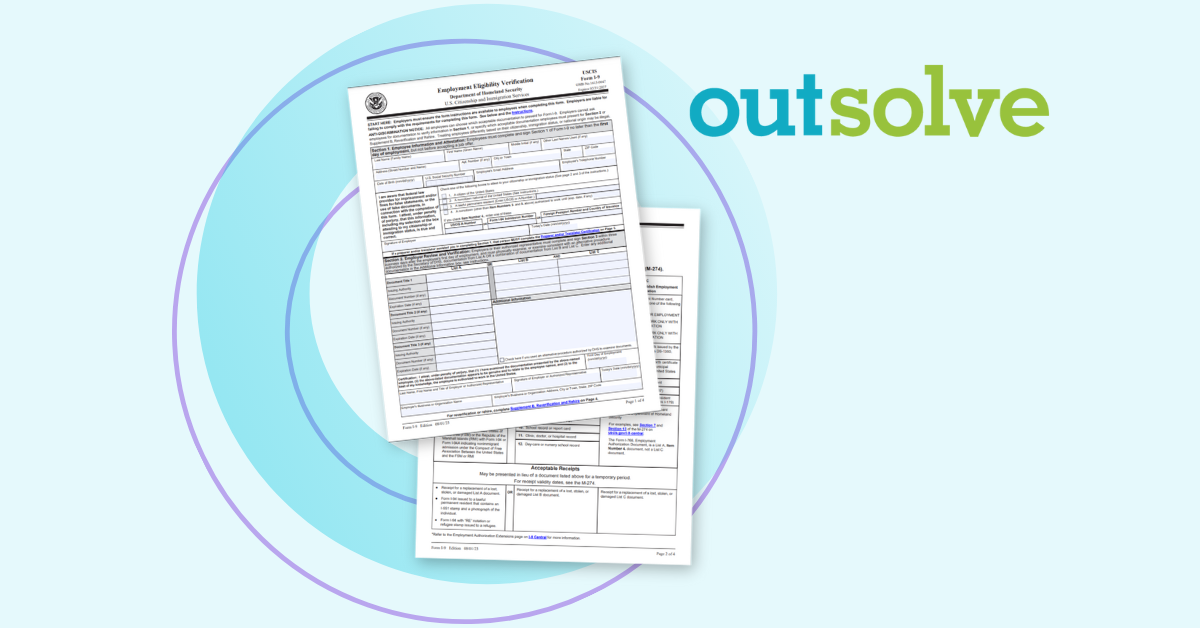
Ensuring compliance with employment work authorization requirements is a crucial responsibility for employers. Form I-9 is the official document required by U.S, law that employers use to verify employee identity and employment eligibility of individuals hired in the United States.
With increased workplace investigations and heightened enforcement activity around immigration, HR teams must be proactive about maintaining compliant I-9 processes.

Top Takeaways for HR
- Workplace audits and inspections have surged under the Trump administration, signaling an increased importance to have a tight I-9 process in place to avoid fines and penalties.
- Section 1 must be completed by the employee no later than their first day of employment, and Section 2 must be finalized by the employer within three business days of the hire date.
- Recent regulatory adjustments have elevated common administrative errors from minor procedural oversights into fineable, substantive violations.

What Is Form I-9 and Why Is It Important?
Form I-9 is a mandatory U.S. government document that employers are required to complete for every new employee hired onto their payroll. Also known as the Employment Eligibility Verification form, it verifies both identity and authorization to work in the United States.
The form contains sections that must be completed by both the employee and employer under penalty of perjury. It also includes strict completion timelines that employers must follow.
The importance of I-9 compliance can't be overstated. Employers who fail to properly verify work authorization risk substantial fines, penalties, and potential legal action. The U.S. Department of Homeland Security (DHS) and Immigration and Customs Enforcement (ICE) regularly conduct I-9 audits across organizations nationwide.
In most organizations, Form I-9 compliance falls under the HR function.
HR Pro Tip: Create a standardized onboarding workflow that includes Form I-9 completion checkpoints. Consistency helps reduce missed deadlines and incomplete forms during busy hiring periods.
Understanding Unauthorized Employment
Unauthorized employment occurs when individuals who are not legally eligible to work in the U.S. are employed. This may happen when someone lacks proper documentation or their work authorization has expired.
Proper I-9 compliance helps organizations prevent unauthorized employment and protects employers from federal penalties and fines.
Form I-9 Specifics
The U.S. Citizenship and Immigration Services (USCIS) created Form I-9 as part of an effort to prevent the employment of unauthorized workers. The Immigration Reform and Control Act of 1986 (IRCA) established the federal requirement for identity and work authorization verification through Form I-9.
Form I-9 includes:
- Section 1: Completed by the employee
- Section 2: Completed by the employer
- Supplement A: Identification of Preparer and/or Translator
- Supplement B: Reverification and Rehire (formerly Section 3)
IRCA created three primary obligations for employers:
- Employers cannot knowingly hire undocumented workers or continue employing individuals after learning they are unauthorized to work.
- Employers must verify employment eligibility through Form I-9.
- Employers must avoid discrimination based on national origin, citizenship, or immigration status during hiring and verification.
The requirement applies to all full-time and part-time employees hired as a W-2 employee on or after November 7, 1986, regardless of citizenship or immigration status. Those hired prior to that date don’t fall under IRCA and are not required to complete Form I-9.
E-Verify and Form I-9
E-Verify is an online government system that allows employers to electronically confirm an employee’s identity and work eligibility in the U.S.
While Form I-9 is mandatory for all employers, E-Verify participation is optional for many employers, with some exceptions. E-Verify is required for:
- Federal contractors whose contracts include the Federal Acquisition Regulation (FAR) clause
- Certain states
- Employers conducting remote I-9 document inspections through video verification rather than in person
E-Verify compares Form I-9 information against records maintained by the Social Security Administration (SSA) and DHS. Possible E-Verify results include:
- Employment Authorized: Information matches government records.
- Tentative Non-Confirmation (TNC): Information discrepancies require additional action.
HR IRL: A remote employee starts work from another state and cannot appear in person for document inspection. If your organization participates in E-Verify, you may use remote verification procedures through a live video interaction while maintaining compliance with USCIS guidance.
Employers using remote verification should establish written procedures and train HR staff to apply the process consistently across all hires.
Employee vs. Employer Responsibilities
Both employees and employers have responsibilities during the I-9 process.
Employees must provide and complete:
- Section 1 information must be completed by the employee.
- Required identity and employment authorization documentation must be produced by the employee.
- Accurate personal information must be supplied by the employee.
- Signed attestation by the employee confirming the information is truthful.
Employers must:
- Review employee documentation and complete Section 2 verification.
- Ensure documents appear genuine and relate to the employee.
- Complete required sections within mandated timelines.
- Avoid specifying which documents employees should present.
- Store the I-9 documentation in accordance with USCIS guidelines.
The List of Acceptable Documents determines which records satisfy identity and work authorization requirements.
Key Timeframes and Deadlines
Form I-9 deadlines are part of IRCA’s compliance and are non-negotiable.
Employees must complete Section 1:
- After accepting a job offer
- No later than their first day of work
Employers must complete Section 2:
- Within three business days of the employee’s start date
- If an employee works fewer than three days, Section 2 must be completed no later than the employee’s first day of work for pay. This ensures that the verification process is completed promptly, even for short-term employment.
HR Pro Tip: Set automated reminders within your onboarding or HRIS platform to track Form I-9 completion deadlines and reverification dates.
How to Complete Form I-9
Let’s breakdown the two main components of Form I-9, Section 1 and Section 2, step-by-step. USCIS also has a comprehensive I-9 handbook for employers.
Section 1: Employee Information and Attestation
Employees must provide:
- Full name
- Address
- Date of birth
- Social Security number
- Email address
- Phone number
- Citizenship or immigration status
- Work authorization status (U.S. citizen, permanent resident, etc.)
Employees must also sign and date the form under penalty of perjury. Missing information in Section 1 may result in compliance violations.
Section 2: Employer Review and Verification
Section 2 may be completed by:
- HR personnel
- Hiring managers
- An authorized I-9 representative
Within three business days of the employee’s start date, the employer must:
- Examine employee documents
- Determine documents appear genuine and relate to the employee
- Record document information
- Enter employment start date
- Sign and date the form
Any missing information in Section 2 may also result in violations.
Acceptable Employee Documents for I-9 Verification
The U.S. government provides a List of Acceptable Documents and categorizes the documents into three groups:
List A Documents - Establish both identity and employment authorization and must be unexpired, such as:
- U.S. passport
- Permanent Resident Card
List B Documents - Establish identity only, such as:
- Driver’s license
- State-issued ID card
List C Documents - Establish employment authorization only, such as:
- Social Security card
- Birth certificate
Employees must provide either:
- One List A document, or
- One List B document plus one List C document
Employers cannot instruct employees which documents to present.
Remote Verification Considerations for Hybrid and Remote Workers
As remote and hybrid work models continue, employers should evaluate compliant remote verification procedures.
Employers enrolled in E-Verify may inspect documents remotely using live video interactions. USCIS enacted remote verification guidance in August 2023 that can be found here.
Remote verification procedures should include:
- Consistent written processes
- Secure document handling practices
- Proper employee training
- Documentation of remote inspection procedures
Form I-9 Retention Rules
HR teams are typically responsible for maintaining Form I-9 records according to federal I-9 retention rules.
Employers must retain Form I-9 for all current employees. For terminated employees, employers must retain records for:
- Three years after the date of hire, or
- One year after termination
Whichever date is later determines the purge date.
It is generally recommended to store Form I-9 separately from personnel files to:
- Simplify government inspections
- Protect sensitive employee information
- Improve privacy and confidentiality compliance
HR Pro Tip: Conduct annual or bi-annual retention reviews to identify outdated I-9 forms eligible for purging. Maintaining unnecessary forms can increase audit exposure.

I-9 Audits and Self-Checks
Conducting periodic internal I-9 audits is an effective way to identify errors and improve your compliance readiness before receiving a Notice of Inspection. They’re also a good way to see if you have any practices or issues that could trigger an I-9 audit. It is recommended to do at minimum an annual audit. Quarterly audits can help break the process into manageable chunks and are increasingly advised for high-risk industries.
Audits may review:
- Electronic forms
- Paper forms
- All I-9s or a neutral sample selection
Common Self-Audit Findings
Internal reviews often uncover:
- Missing information
- Incorrect dates
- Incomplete sections
- Missing signatures
Errors in Section 2 or Supplement B (Reverification and rehire) may generally be corrected by the employer. Employees must correct errors found in Section 1.
You should also maintain records documenting:
- Forms reviewed
- Errors identified
- Corrections completed
- Personnel involved in the audit process

Common I-9 Compliance Challenges
Some of the more frequent mistakes that can occur with I-9 compliance include:
- Incomplete or Missing Forms - Missing or incomplete forms can lead to substantial penalties.
- Use of Expired Documents - Employers must carefully monitor document expiration dates. Some Employment Authorization Documents (EADs) may qualify for automatic extensions when paired with proper documentation.
- Failure to Update Supplement B - Employers must update Supplement B when an employee’s work authorization expires or they’re rehired within three years of the date the original Form I-9 was completed. Some employers also use Supplement B to record name changes upon marriage.
- Discrimination Risks - Employers cannot request specific documents based on citizenship status, appearance, accent, or perceived nationality. Examples include asking non-U.S. citizens for DHS-issued documents while accepting different documents from U.S. citizens or treating employees differently during verification based on their appearance, accent, or perceived nationality.
- Retention and Storage Issues - Improper storage or inaccessible forms may create compliance risks during inspections.
- Lack of Training - Insufficient HR training often contributes to avoidable errors and penalties if under audit.
It’s critical to be aware, that in March 2026, ICE redefined what may constitute a substantive I-9 violation. Examples of errors that were once procedural or technical and are now considered substantive include:
- Missing date of hire
- Missing date of birth
- Missing title of the employer or authorized representative
- Failure to date Sections 1 or 2
- Failure to enter rehire, when applicable
- Incorrect use of Spanish language I-9 outside of Puerto Rico
- Preparer and/or translator errors
- Failing to check the alternative procedure box in Section 2, when applicable and verifying remotely
- Failing to be enrolled in and in good standing with E-Verify if verifying remotely
- Using an electronic I-9 system that falls short of specific standards
Penalties for I-9 Non-Compliance
Failure to comply with I-9 regulations can result in severe consequences imposed by ICE. These penalties may include:
- Significant fines for missing or improperly completed forms
- Substantive violation penalties that are determined based on business size, violation severity, and whether the employer demonstrated good-faith compliance efforts
- Penalties up to $28,619 per worker for knowingly hiring unauthorized workers
- Technical violation fines for uncorrected errors ranging from $716 to $2,861 per form
- Loss of federal contracts and debarment
Best Practices for I-9 Compliance
To reduce risk and strengthen compliance, HR teams should:
- Implement standardized I-9 policies and procedures
- Regularly audit I-9 forms
- Use electronic I-9 systems to reduce manual errors
- Train HR staff and authorized representatives regularly
- Monitor regulatory updates and changing enforcement priorities
How HR Compliance as a Service (HR CaaS) Can Help
Many organizations are moving beyond “check-the-box” compliance by partnering with compliance experts who provide ongoing guidance, audit support, training, and technology solutions. An HR compliance as a service (HR CaaS) partner, such as OutSolve, can help you and your HR teams stay proactive, especially as enforcement activity continues to increase.
What Form I-9 Compliance Means for Your Organization
Form I-9 compliance is both a legal requirement and a critical HR responsibility. By understanding proper verification procedures, maintaining accurate documentation, conducting regular audits, and staying informed on regulatory changes, organizations can reduce compliance risks and strengthen workforce readiness.
If you are looking for guidance on Form I-9 best practices and an HR CaaS partner, then OutSolve can help. We also offer an end-to-end Form I-9 solution backed by experienced compliance experts who provide ongoing support throughout the employment verification process.
Reach out to us today to learn more.
Watch this video for a quick overview on Form I-9 and its importance.
Form I-9 FAQs
-
What is Form I-9 used for?
Form I-9 is used to verify the identity and employment authorization of individuals hired to work in the United States.
-
Is E-Verify required for all employers?
No. E-Verify is optional for many employers, but it is required for certain federal contractors with FAR E-Verify clauses, certain state requirements, and organizations conducting remote document verification.
-
How long must employers keep Form I-9?
Employers must retain Form I-9 for all current employees. For terminated employees, forms must be kept three years after the hire date or one year after termination, whichever is later.
-
Can employers complete Form I-9 remotely?
Yes, employers enrolled and in good standing with E-Verify may use authorized remote verification procedures that comply with USCIS guidance.
-
Who can complete Section 2 of Form I-9?
Section 2 may be completed by an HR representative, hiring manager, or I-9 authorized representative acting on behalf of the employer.





E-Verify’s Status Change Report Require Employer Attention
 Alissa Horvitz: Sep 22, 2026, 8:00:00 AM
U.S. Citizenship and Immigration Services (USCIS) recently published additional frequently asked questions (FAQs) regarding the E-Verify Status...
ICE Notice of Inspection: HR Response Checklist
 OutSolve: Sep 21, 2026, 11:42:30 AM
When ICE issues a Notice of Inspection, you generally have three business days to respond. That timeline alone can make the process overwhelming and...

The Hidden Costs of Fragmented Compliance: What Silos Are Doing to Your Bottom Line
OutSolve: Sep 16, 2026, 10:06:46 AM
HR teams are busy year-round balancing performance goals, audit readiness, and a seemingly endless list of compliance requirements. As part of your...