


california pay data reporting
Welcome to the ultimate guide on the California Pay Data Reporting Laws. We're here to help you understand the law, and what it means for your company.
Reports for 2025 are due by Wednesday, May 13, 2026.
from the experts
Bryan Ishmael, Senior Consultant at OutSolve breaks down the latest in California Pay Data Reporting in this episode of In & OutSolve.
what is the california pay data report
In accordance with California law, private employers with a workforce of 100 or more employees and/or 100 or more workers hired through labor contractors are obligated to submit an annual report to the Civil Rights Department (CRD). This report includes vital information regarding pay, demographics, and other workforce data. The requirement stems from Government Code section 12999, as amended by Senate Bill 1162 (SB1162).
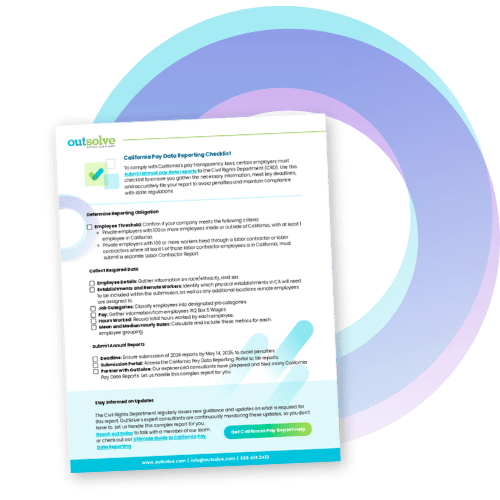
ca pay data report checklist
Don’t let California’s pay data reporting deadline sneak up on you, make sure you're fully prepared. Fill out the form to instantly download our California Pay Data Reporting Checklist and ensure you have all required information so your submission is accurate and compliant. Download today!
more ca pay reporting resources
California Pay Data Report Checklist for HR Professionals

California Pay Data Reporting Portal Now Open

California Employers: SB 294 Requires Immediate Action

California SB 464 Mandates Stricter Pay Data Reporting Requirements

California Pay Data Reporting Portal Now Open

The Business Case for Pay Equity in 2025

Ultimate Guide to Pay Transparency Laws by State

Simple Steps for Implementing Pay Equity and Fair Pay
california pay frequently asked questions
Find answers and general information quickly. Not finding answers here? Shoot us a message!
history & legal foundation
In 2020, California passed Senate Bill 973, requiring employers with 100 or more employees to report pay and hours-worked data to CRD by establishment, pay band, job category, sex, race, and ethnicity. The legislation addresses the persistent gender pay gap, which results in significant wage losses for women in the state. Pay discrimination affects not only women but also families and the economy. The reports aim to encourage self-assessment of pay disparities and voluntary compliance with equal pay and anti-discrimination laws. Additionally, CRD is authorized to enforce the Equal Pay Act and the Fair Employment and Housing Act to combat unjustified pay disparities and discrimination. In 2022, Senate Bill 1162 was passed to further enhance pay data reporting, including for private employers with 100 or more workers hired through labor contractors. In 2025, Senate Bill 464 was passed mandating stricter requirements for storing demographic data, penalties for non-compliance, and the way employers classify their job categories.
Effective January 1, 2023, Senate Bill 1162 enhances the California pay data reporting system. It requires private employers with at least 100 employees to file a Payroll Employee Report, regardless of whether they file a federal EEO-1 report. Employers with 100 or more employees hired through labor contractors must also file a Labor Contractor Employee Report, disclosing the ownership names of all labor contractors used. Both reports must include the mean and median hourly rates of employee groupings. The option to submit a federal EEO-1 report as satisfaction for the state reporting requirement is eliminated. The annual deadline for submitting pay data reports is changed to the second Wednesday of each May. CRD is authorized to impose penalties on employers and labor contractors who fail to comply. Senate Bill 1162 also requires certain employers to include pay scales on job postings. This requirement is enforced by the Labor Commissioner’s Office. Contact the Labor Commissioner’s Office/DLSE for more information.
The pay data reporting requirement is contained in Government Code section 12999. In addition, CRD intends to issue regulations implementing this statute consistent with CRD’s existing regulations. (California Code of Regulations, Title 2, Division 4.1)
SB 464 includes changes for both the 2025 reporting period and the 2026 reporting period. Effective January 1, 2026, employers and labor contractors must store demographic data collected for the report SEPARATE from employee personnel records. In addition, penalties for non-compliance (failure-to-file) will become mandatory under the CRD. Effective January 1, 2027, employers must classify their employees using the 23 job categories from the Standard Occupational Classification (SOC) system, a change from the 10 current EEO-1 job categories required now.
data collection & security
CRD can develop, publish, and publicize aggregate reports annually based on the data obtained under this section, ensuring data anonymity. In 2022, CRD published aggregate results from the 2020 Reporting Year.
CRD “shall maintain pay data reports for not less than 10 years.” Gov. Code § 12999(j).
CRD takes data security and privacy very seriously. CRD’s pay data reporting system uses end-to-end encryption for transmission and storage of all employer-submitted data. The system is housed in a secure government cloud environment that meets FedRAMP and NIST Federal and State requirements for data protection.
In Senate Bill 973, the California Legislature explained that the Obama Administration proposed revising the EEO-1 to include reporting pay data by gender, race, and ethnicity starting in 2018. However, the Trump Administration halted the implementation of this rule in August 2017. The EEOC collected these pay data for 2017 and 2018 following a federal court ruling but has since discontinued its collection. In 2022, the National Academy of Sciences published a study on the EEOC's federal pay data collection.
reporting requirements & logistics
Except as allowed by Government Code section 12999, CRD, the Labor Commissioner’s Office/DLSE, and their staff are prohibited from making public any individually identifiable information obtained under this section before an investigation or enforcement proceeding is initiated. Individually identifiable information refers to data associated with a specific person or business submitted under this section. Additionally, Government Code section 12999(h) states that any individually identifiable information submitted to CRD is considered confidential and not subject to disclosure under the California Public Records Act.
The deadline for filing pay data reports with CRD is the second Wednesday of May each year. For pay data reports covering Reporting Year 2025, the filing deadline is May 13, 2026. If CRD does not receive a required report by the deadline, they may seek a court order for compliance. CRD can recover costs and the court may assess a civil penalty against employers or labor contractors.
Employers must use CRD’s pay data portal to submit their reports. CRD will not accept reports by email or hard copy. The portal is available at https://pdr.calcivilrights.ca.gov. To file a pay data report, an employer registers in the portal and provides information about their business, parent/affiliates (if any), and other information. Then, the employer creates and submits its Payroll Employee Report and/or Labor Contractor Employee Report, depending on the employer’s reporting obligations. If an employer is obligated to submit both report types, the employer submits its Payroll Employee Report separate from its Labor Contractor Employee Report. Please see more details here - https://calcivilrights.ca.gov/paydatareporting/
To file a Payroll Employee Report or a Labor Contractor Employee Report, an employer's official must certify the accuracy of the report, prepared in accordance with CRD's instructions. The certifying official must have knowledge of the report's information, review it, and be authorized to file it on behalf of the employer. Client employers must have their own official certify the report, not the PEO, HRO, or labor contractor assisting in its preparation and filing. The certifying official can authorize someone else to electronically file the certification. See Part VI for more on PEOs and HROs.
Employers must file a Payroll Employee Report with CRD if they have 100 or more employees (inside and outside of California) and at least one employee in California. When reporting to CRD, employers should include all employees assigned to California establishments or working within California. However, employers should not report employees working outside of California and assigned to an establishment outside of California.
A pay data report covers a single employer, its component establishments (if applicable), and its payroll employees or labor contractor employees assigned to those establishments. Multiple entities can be considered a single employer if they meet the criteria for an "integrated enterprise." Affiliated entities that make up an integrated enterprise have the option to file a combined pay data report for multiple entities. Otherwise, each affiliated company must file a separate report.
To file a Payroll Employee Report for Reporting Year 2025, employers must follow CRD’s instructions provided in the portal, user guide, template, and FAQs. They need to determine if filing is required, identify employees in the "Snapshot Period," gather establishment information, record employee details, calculate group statistics within each establishment, gather additional employer information, register in the portal, provide necessary information, correct any errors, certify the final report, and submit by May 13, 2026.
For more details visit https://calcivilrights.ca.gov/paydatareporting/faqs/
key dates & definitions
A pay data report shall “cover the prior calendar year, which, for purposes of this section, shall be referred to as the ‘Reporting Year.’” Gov. Code § 12999(a)(1). For example, a Payroll Employee Report due to CRD in 2026 will contain pay data from calendar year 2025 for employees employed during the Snapshot Period; 2025 is the Reporting Year.
The Snapshot Period is a chosen pay period between October 1 and December 31 of the Reporting Year. Employers use this period to identify the employees to be reported on in the pay data report. It is not the period for determining an employee's pay or hours worked, but rather a fixed time frame for identifying payroll employees. Whether an employee was paid during the Snapshot Period does not matter, only whether they were employed during that time.
employer obligations & requirements for the payroll employee report
For purposes of pay data reporting to CRD, Government Code section 12999(k)(1) defines “employee” to mean “an individual on an employer’s payroll, including a part-time individual, and for whom the employer is required to withhold federal social security taxes from that individual’s wages.” Only employees who meet this definition are counted as “employees” for the purposes of the pay data report. See below for more information on the labor contractor employee reporting requirement.
Private employers with 100 or more employees, including part-time employees, are required to submit a pay data report to CRD under Government Code section 12999(a)(1). This includes employees located inside and outside of California. Employers with fewer than 100 employees may still be required to file if they are affiliated with other entities that together employ a total of 100 or more employees. For more information on determining if affiliated entities constitute an integrated enterprise, please see https://calcivilrights.ca.gov/paydatareporting/faqs/
penalties
Senate Bill 1162 imposes penalties on employers who fail to submit required pay data reports. The Department can require non-compliant employers to file the necessary reports and seek civil penalties of $100 per employee for non-compliance, increasing to $200 per employee for subsequent failures. These penalties also apply to labor contractors who fail to provide pay data to client employers. The Department is authorized to recover its enforcement costs. Gov. Code § 12999(f).
telework & remote employees
Yes.
Example: if an employer has 100 employees assigned to an establishment in Oregon (five of whom are teleworking from California during the Snapshot Period) and 100 employees assigned to an establishment in Arizona (five of whom are teleworking from California during the Snapshot Period), the employer would submit a report with: (1) establishment-level data for the Oregon establishment that covers only the five employees teleworking from California; and (2) establishment-level data for the Arizona establishment that covers the five employees teleworking from California.
take the next step today
At OutSolve, we specialize in helping employers submit their California Pay Data Report. Our consultants will guide you through the reporting process and assist you with avoiding common pitfalls. Please complete the form below or contact us at info@outsolve.com.
latest compliance updates
Ultimate Guide to Pay Transparency Laws by State
HR Compliance Checklist: What Every HR Pro Needs to Know