Missing even one HR Compliance requirement can expose your company to costly penalties, legal claims, government audits, and reputational damage. That's why a proactive, organized approach to HR compliance is a must.
Smart organizations are checking and double checking their compliance requirements and working with an HR Compliance as a Service (HR CaaS) provider to address gaps in coverage. HR CaaS providers cover numerous areas of compliance, and expert consultants can offer guidance and help you proactively plan even when changes happen.
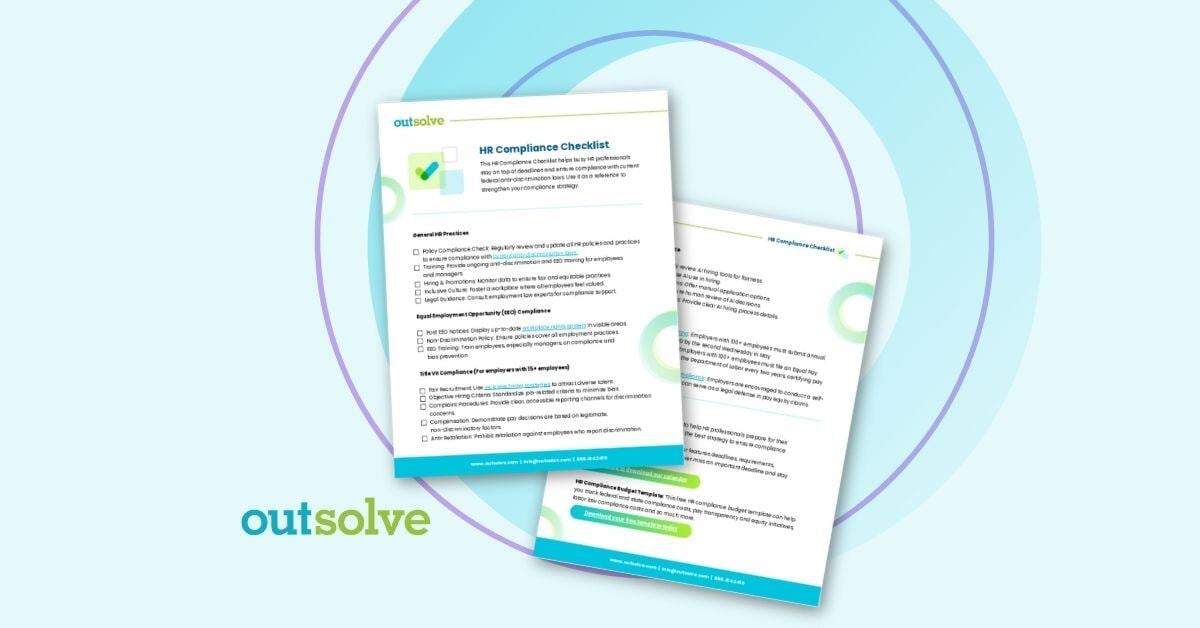
OutSolve's HR Compliance Checklist helps busy HR teams stay on top of deadlines, evaluate current practices, and strengthen their overall compliance strategy. Use this checklist as a practical reference to identify potential gaps, prioritize compliance initiatives, and build a stronger foundation for your HR program.
.png?width=600&height=314&name=hr-compliance-checklist-CTA%20(1).png) What’s Inside the HR Compliance Checklist
What’s Inside the HR Compliance Checklist
Use this checklist to strengthen your compliance strategies in:
- General HR Practices
- Hiring & Verification
- Anti-Discrimination Laws
- Demographic Protections
- Compensation & Pay Equity
- Federal Employment & Workplace Operations
- Federal Reporting Requirements
- State Requirements
- Labor Law Poster Compliance
- Best Practices for HR
General HR Practices
- Policy Compliance Check: Regularly review and update all HR policies and practices to ensure compliance with current anti-discrimination laws.
- Training: Provide ongoing anti-discrimination and EEO training for employees and managers.
- Hiring & Promotions: Monitor data to ensure fair and equitable practices.
- Inclusive Culture: Foster a workplace where all employees feel valued.
- Legal Guidance: Consult employment law experts for compliance support.
- Employee Handbook: Review your handbook annually and update policies based on new regulations.
- Compensation: Conduct pay equity audits or compensation benchmarking to ensure your pay practices are fair and competitive.
- Employee Engagement: Evaluate your employee engagement through surveys and incorporate feedback to make annual updates.
- Training: Analyze your employee training schedule to ensure you are meeting all requirements.
Hiring & Verification
- Form I-9 Compliance
- Analyze your Form I-9 processes and look for ways to strengthen verification and storage.
- Train HR and hiring managers on Form I-9 best practices to reduce risk.
- Section 1: Employee must complete Section 1 by their first day of employment.
- Section 2: Employer or authorized Form I-9 representative must complete Section 2 by day three of employment.
- Remote Verification: Section 2 verification can be done remotely if you are enrolled and in good standing with E-Verify.
- Retention Requirements: For terminated employees, retain their Form I-9 either one year after date of termination or three years after date of hire, whichever is later.
- Internal Audits: Conduct quarterly to annual internal audits to analyze your Form I-9s and correct any mistakes in good faith effort.
- E-Verify Compliance
- Federal Contractors: Identify if you have a FAR E-Verify clause in your government contract that requires you to participate in E-Verify.
- State Requirements: Certain states require the use of E-Verify. Check out the list here to see if you are in one of them.
- Submit all cases through E-Verify and monitor the outcome for confirmations or Tentative Nonconfirmations (TNC) which require management escalation.
- AI in Hiring Compliance
- Bias Audits: Regularly review AI hiring tools for fairness.
- Transparency: Disclose AI use in hiring.
- Alternative Applications: Offer manual application options.
- Human Oversight: Ensure human review of AI decisions.
- Candidate Explanations: Provide clear AI hiring process details.
Anti-Discrimination Laws
- Equal Employment Opportunity (EEO) Compliance
- Post EEO Notices: Display up-to-date workplace rights posters in visible areas.
- Non-Discrimination Policy: Ensure policies cover all employment practices.
- EEO Training: Train employees, especially managers, on compliance and bias prevention.
- Title VII Compliance (For employers with 15+ employees)
- Fair Recruitment: Use inclusive hiring strategies to attract diverse talent.
- Objective Hiring Criteria: Standardize job-related criteria to minimize bias.
- Complaint Procedures: Provide clear, accessible reporting channels for discrimination concerns.
- Compensation: Demonstrate pay decisions are based on legitimate, non-discriminatory factors.
- Anti-Retaliation: Prohibit retaliation against employees who report discrimination.
- Age Discrimination in Employment Act (ADEA)
- Threshold: Receive federal financial assistance and have 20+ employees
- Requirements: Protects applicants and employees who are 40 years of age or older from age discrimination in hiring, promotions, termination, compensation, or terms, conditions, or privileges of employment.
- Performance Reviews: Ensure fair, age-neutral evaluations.
- Layoff Criteria: Base decisions on objective, job-related factors.
- Benefit Plans: Avoid age-based discrimination in benefits.
- Succession Planning: Ensure opportunities are age inclusive.
Demographic Protections
- ADA & ADAAA Compliance (For employers with 15+ employees)
- Interactive Process: Engage in dialogue with employees about accommodation needs.
- Provide Accommodations: Ensure reasonable adjustments without undue hardship.
- Confidentiality: Keep medical information private and secure.
- Accessibility Audit: Ensure workplace and online tools are disability friendly.
- Manager Training: Train leaders on handling disability accommodations.
- Expanded Disability Definition: Apply ADAAA’s broader disability protections.
- Pregnancy Discrimination Act (PDA)
- Equal Treatment: Treat pregnancy-related conditions like any other temporary disability.
- Accommodations: Offer adjustments for pregnant employees as needed.
- Leave & Return: Ensure fair leave policies and a smooth return-to-work process.
Compensation & Pay Equity
- Equal Pay Act (EPA)
- Pay Audits: Regularly review salaries to identify gender pay gaps.
- Justify Differences: Ensure pay variations are based on valid factors.
- Pay Transparency: Encourage open conversations about compensation.
- Pay Equity Audit
- Conduct an annual pay equity audit to ensure your pay is fair
- Collect Compensation Data: Pull current compensation data, such as base salary, bonuses, stock options, and other pay elements and include employee demographics (where legally permissible), job titles, performance ratings, and tenure.
- Benchmark Internally and Externally: Compare compensation within job families, levels, and locations. Then benchmark against market rates to see how your pay stacks up externally.
- Analyze for Gaps: Use analytic tools or statistical modeling to identify unexplained disparities, which are those not justified by performance, tenure, or other neutral factors. Flag any anomalies, especially patterns that suggest systemic issues.
- Develop a Corrective Action Plan: Work with leadership to allocate budget for salary adjustments, redesign comp structures, or update job architecture. Document your rationale and include consistent communication with impacted employees.
Federal Employment & Workplace Operations
- Fair Labor Standards Act (FLSA) Compliance
- Minimum Wage: Pay at least the federal or applicable state minimum wage.
- Overtime Pay: Ensure proper overtime compensation for non-exempt employees.
- Accurate Records: Maintain precise wage and hour records.
- Classification: Correctly categorize employees as exempt or non-exempt.
- National Labor Relations Act (NLRA)
- Employee Rights: Allow workers to discuss wages and working conditions.
- Good Faith Bargaining: Negotiate with unions fairly.
- Avoid Retaliation: Do not interfere with employees’ union rights.
- Review Policies: Ensure social media policies respect NLRA rights.
- OSHA Workplace Safety
- Risk Assessments: Regularly check for hazards and safety risks.
- Compliance: Follow all OSHA regulations.
- Safety Training: Train employees on workplace safety.
- Incident Reporting: Keep records of work-related injuries and illnesses.
- Family and Medical Leave Act (FMLA) Compliance (For employers with 50+ employees)
- Eligibility Checks: Determine if employees qualify for leave.
- Leave Administration: Ensure proper tracking and approvals.
- Health Benefits: Maintain benefits during FMLA leave.
- Job Restoration: Return employees to their roles post-leave.
- Notice Posting: Display FMLA rights in the workplace.
Federal Reporting Requirements
- Federal Contractor Anti-Discrimination Executive Orders EO 14173 and EO 14398
- Workforce Analytics Audit: Conduct annual hiring selection audit to ensure all decisions are merit-based and align with federal anti-discrimination laws.
- Subcontractor Oversight: If you are a prime contractor, procedures need to be put in place to ensure they are complying with EO 14398.
- DEI Audit: Review programs for compliance with anti-discrimination laws.
- Legal Alignment: Adjust DEI programs to avoid unlawful quotas or preferences.
- Expert Review: Conduct DEI audits under attorney-client privilege.
- Policy & Training: Update policies and train HR on compliance risks.
- Documentation: Keep records of compliance efforts and annual reviews.
- Merit-Based Hiring: Ensure you are hiring all candidates based on merit and that you have the documentation to prove it.
- Section 503 of the Rehabilitation Act Compliance (Federal Contractors)
- Accommodations Process: Establish a clear process for reasonable accommodations.
- Outreach & Recruitment: Conduct outreach and positive recruitment activities designed to attract qualified individuals with disabilities.
- Evaluate Effectiveness: Assess the effectiveness of disability outreach and recruitment efforts and document the criteria used to evaluate results.
- AAP Development: Develop and maintain an affirmative action plan annually if required.
- VEVRAA Compliance (Federal Contractors)
- Veteran Hiring Benchmarks: Set and track veteran hiring benchmarks.
- Self-Identification: Provide applicants the option to disclose veteran status.
- AAP & Job Listings: Maintain affirmative action plans and distribute job postings to veteran services.
- Outreach & Recruitment: Conduct outreach and recruitment activities designed to identify and attract protected veterans.
- Effectiveness Assessment: Annually evaluate the effectiveness of veteran outreach efforts and document the criteria used to make that determination.
- VETS-4212 Report: Submit required veteran employment data annually.
- VETS-4212 Reporting
- Data Tracking: Monitor veteran hiring statistics.
- Annual Submission: File the VETS-4212 report before the deadline.
- EEO-1 Reporting (For companies with 100+ employees or federal contractors with 50+ employees)
- Data Collection: Track workforce demographics.
- Annual Filing: Submit the EEO-1 report on time.
- Please note: The EEOC proposed rescinding EEO-1 Reports. At this time, no changes have been made as we await a final rule.
State Requirements
- State Pay Data Reporting
- California Pay Data Reporting: Employers with 100+ employees in the company with at least 1 working in California must submit annual pay data reports to the CRD by the second Wednesday in May.
- Illinois Pay Data Reporting: Employers with 100+ employees in Illinois must file an Equal Pay Registration Certificate with the Department of Labor every two years, certifying pay equity compliance.
- Massachusetts Pay Equity Compliance: Employers are encouraged to conduct a self-evaluation under MEPA, which can serve as a legal defense in pay equity claims. Employers with 100 or more in Massachusetts need to submit a MA EEO-1 Report.
- Minnesota: Employers with 40 or more employees seeking public contracts over $100,000 must obtain a Workforce Certificate, and for contracts over $500,000, an Equal Pay Certificate is also required.
- State Pay Transparency Laws
- The following states have a pay transparency law in place. Consult our Ultimate Guide to State Pay Transparency Laws to ensure compliance for each state you advertise job listings in.
Labor Law Poster Compliance
- Check for Updates: Regularly check your state's labor department website
- Automatic Services: Subscribe to a service that monitors changes and automatically ships new posters.
- Mid-Year Review: Conduct a mid-year poster review to ensure all posters are up to date.
- Train HR: Keep your staff informed of the importance of poster compliance.
Best Practices for HR
- General HR Practices
- Outsource your HR compliance requirements to an HR Compliance as a Service (HR CaaS) provider who has expert consultants monitoring the latest regulatory updates and can provide continuous assurance and guidance to your team
- I-9 Compliance
- Use an electronic system and don’t rely on paper Form I-9s that can get easily misplaced
- Audit Form I-9s on regular basis—annually for most industries and quarterly for high-risk industries
- Have a neutral, third-party audit your Form I-9s and not the people who complete them on a regular basis
- If you have a remote or hybrid workforce, enroll in E-Verify so you can conduct remote verifications
- Don’t wait to have your employee complete Section 1 on their first day; you can send them the form beforehand to get the process started
- Pay Transparency & Compensation Strategy
- Conduct an annual pay equity audit to confirm your pay is equitable before you have to include your salary ranges in job postings
- Benchmark your compensation externally and internally at least once a year to stay competitive
- Federal Requirements and Reporting
- Outsource these mandatory reports and requirements to an HR CaaS provider who will monitor any changes for you and interpret the gray areas
- Labor Law Poster Compliance
- Sign up for an automatic poster subscription service the automatically ships posters to all of your locations anytime there is a mandatory update
- Anti-Discrimination and Merit-Based Employment
- Regularly audit employment policies, workforce programs, and decision making practices to confirm they are job-related, consistently applied and aligned with anti-discrimination laws; or consult an HR CaaS provider to conduct annual audits
What This HR Compliance Checklist Means for Your Organization
HR compliance isn't a “one and done” or transactional project. It's an ongoing process that requires regular monitoring, policy updates, employee training, and documentation. By reviewing this checklist throughout the year, you can stay ahead of changing regulations, reduce compliance risk, and create more consistent HR practices.
This checklist provides a comprehensive and practical framework for keeping your compliance program on track, whether you're evaluating Form I-9 compliance, preparing required federal reports, conducting pay equity audits, navigating state pay transparency laws, or reviewing workplace policies,
If you need additional support, OutSolve's HR compliance experts and HR compliance as a service (HR CaaS) partnership can help with Form I-9 and E-Verify compliance, federal contractor requirements, compensation benchmarking, pay equity audits, labor law posters, state reporting, HR compliance consulting, and ongoing compliance management.
Contact OutSolve to learn how our team can help simplify compliance so your HR team can focus on supporting your workforce with confidence.



HR Compliance Checklist: What Every HR Pro Needs to Know
 Vickie LeNormand: Oct 13, 2026, 10:45:00 AM
Missing even one HR Compliance requirement can expose your company to costly penalties, legal claims, government audits, and reputational damage....

Joint Employer Liability and Compensation Compliance: Businesses Need to Watch Pay Practices Closely
 OutSolve: Oct 8, 2026, 10:17:00 AM
This article is part of an ongoing legal series designed to provide insight and practical guidance on current and emerging workplace compliance...

OutSolve's Beth Montgomery Named a 2026 Women Leader in Consulting
 Mary Madden: Oct 6, 2026, 8:57:09 AM
Beth Montgomery has been named an Industry Specialization Leader in Consulting Magazine's 2026 Women Leaders in Consulting Awards. The honor...