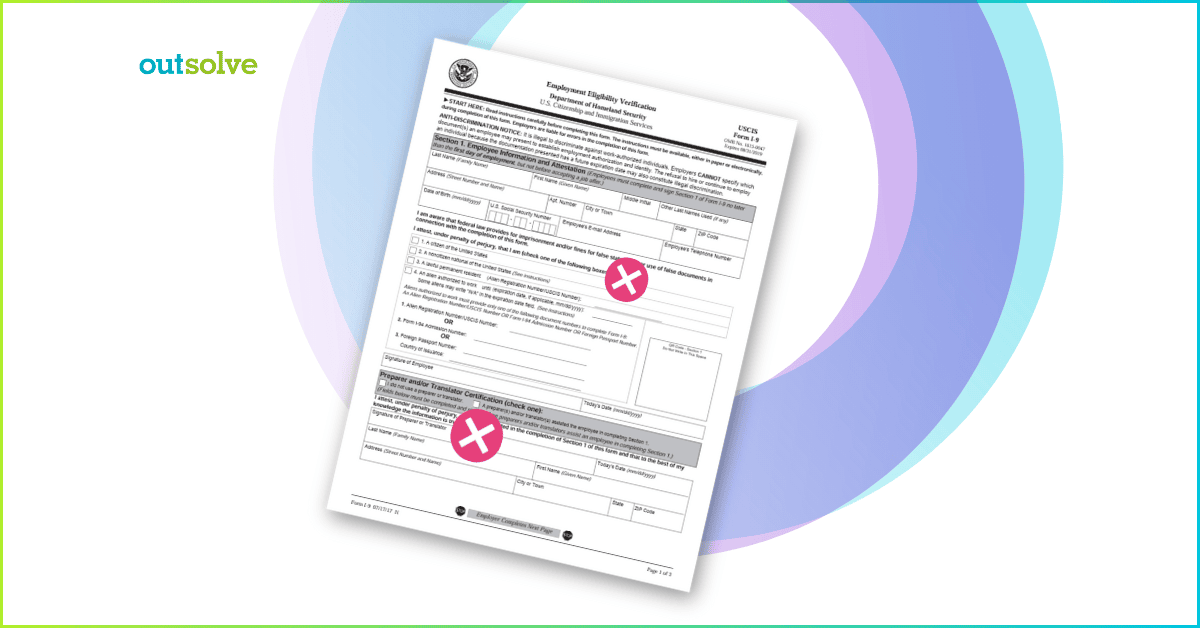
HR teams have no shortage of forms and paperwork, compliance checklists, and onboarding tasks, but few are as critical as Form I-9. Even small mistakes can result in I-9 violations and hefty penalties if audited by ICE.
And now, with ICE’s recent updates to what qualifies as a substantive violation, the chance for error has just gotten larger.
Top Takeaways for HR
- Under the new ICE guidance, several clerical mistakes previously categorized as "technical" (such as a missing date of hire, employee date of birth, or the employer representative’s job title) have been reclassified as Substantive Violations, which trigger higher fines and offer no 10-day grace period for correction.
- ICE is increasingly targeting systemic process gaps, specifically Form I-9 completion deadlines; if Section 1 is not signed by the first day of work or Section 2 is not completed within three business days of the employee’s start date, the error is viewed as a sign of inadequate training and can lead to moderate-to-heavy fines.
- Using an electronic I-9 platform or remote verification process that does not strictly meet DHS standards for security and E-Verify participation is now explicitly listed as a substantive violation, meaning "convenient" digital workflows can create liability if they aren't fully compliant with the latest 2026 standards.

What Are I-9 Violations?
I-9 violations refer to errors, omissions, or failures in the completion, storage, or management of Form I-9. These issues are typically uncovered during an audit by ICE or the Department of Homeland Security (DHS), often beginning with a Notice of Inspection (NOI).
Not all I-9 errors are created equal in terms of risk and they fall into two categories:
- Technical and Procedural Violations
- Substantive Violations
However, ICE’s latest guidance expands what counts as “substantive,” meaning more errors now fall into the more serious category. Understanding these distinctions, and the recent changes, is your first step towards better compliance.
Technical and Procedural Violations
What they are: Technical violations are minor, often clerical or administrative mistakes that typically do not impact the determination of an employee’s work authorization, but they are a lens into whether the employer’s representatives have been trained properly and are paying attention to the form’s requirements. Procedural violations relate to how the I-9 process is handled, including completion timelines, version control, and storage practices. These go beyond typos and reflect gaps in your process.
Examples include:
- Minor data entry errors
- Incomplete non-critical fields (in limited cases)
- Small formatting inconsistencies
- Not completing Section 1 by the employee’s first day
- Section 2 not completed within three business days
- Using an outdated version of Form I-9
- Improper storage or retention practices
Important update: Some errors that were previously considered technical, like missing key dates or fields, may now be treated as substantive violations under ICE’s 2026 guidance.
Potential penalties: Technical violations can still carry financial penalties ranging from $288 to $2,861 per form. ICE may allow a 10-day grace period to correct them during an audit, but repeated issues can signal broader compliance problems. The 10-day grace period starts from the date when ICE notifies the employer regarding the errors.
Substantive Violations - Updated March 2026
What they are: These are the most serious violations and now cover a broader range of errors than ever before. Substantive violations directly impact an employer’s ability to verify work authorization or demonstrate compliance.
What’s changed: In March 2026, ICE expanded the definition of substantive violations and reclassified several technical errors to substantive. This means more errors can now trigger larger penalties.
So, what’s changed? Examples of errors that are now substantive include:
- Missing date of hire
- Missing employee date of birth
- Missing employer or authorized representative title
- Failure to date Section 1 or Section 2
- Failure to enter rehire date (when applicable)
- Errors related to preparers/translators
- Incorrect use of the Spanish I-9 outside Puerto Rico
- Not checking the alternative procedure box (when applicable)
- Using remote verification without proper E-Verify participation
- Non-compliant electronic I-9 systems (failing to meet DHS standards for security, signatures, or recordkeeping)
Potential penalties: The more violations ICE finds as a percentage of the forms it reviewed, the larger the penalty multiplier. Uncorrected technical violations become substantive if not corrected in the 10-day grace period. The combination of uncorrected technical violations and substantive violations can lead to maximum fines and, in severe cases, criminal liability. Penalties for knowingly employing unauthorized workers can range from hundreds to thousands per individual, along with potential debarment from federal contracts.
What this means for HR: There’s now a greater chance of the government finding errors and a higher expectation that your I-9 process and systems need to be fully compliant.
How to Prevent I-9 Violations
The good news? Avoiding most I-9 errors is entirely possible with the right processes, tools, and training in place.
Standardize Your I-9 Process
Create a step-by-step protocol for completing, reviewing, and storing I-9 forms. Consistency is key.
Train HR Staff Regularly
Compliance isn’t static. With ICE expanding enforcement standards, ongoing education is essential. Make sure your HR team and any I-9 authorized representatives understand:
- How to correctly complete Form I-9 and associated timelines
- Updated definitions of technical/procedural and substantive violations
- Which errors now carry higher risk
- Proper correction and annotation methods (never backdate)
- How to handle reverification and document retention requirements
Conduct Proactive Internal Audits
Don’t wait for an NOI. You should be conducting annual self-audits to catch and correct any errors before ICE does. These audits can be seen as a good faith effort if you should receive a NOI and potentially afford you the ability to negotiate a discount in the fine.
- Review active and terminated employee I-9s
- Flag missing or inconsistent data
- Correct errors using proper remediation steps
Leverage Digital Form I-9 Solutions
Manual processes are more prone to human error, which is why many organizations turn to an HR Compliance as a Service (HR CaaS) partner with digital solutions like OutSolve. These tools:
- Guide users through proper form completion
- Flag missing or incorrect fields in real time
- Help ensure compliance with the latest form requirements
- Maintain secure, audit-ready records
- Support compliance with electronic I-9 regulations
With the added complexity around electronic compliance and remote verification for E-Verify users, having the right system in place is more important than ever.
What I-9 Violations Mean for Your Organization
Let’s be honest—no HR team wants to be in the hot seat during an I-9 audit. The stakes are high, and with ICE’s updated definition of substantive violations, the risks are even more real. From technical missteps to substantive violations, even seemingly small errors can trigger large penalties.
What used to be considered a minor paperwork issue that could be fixed without a fine could now count towards penalty calculations. That means greater audit exposure and increased fines.
With enforcement trending upward, now is the time to tighten your I-9 processes, train your team, conduct proactive audits, and invest in the right compliance tools or partners. Contact us today to learn more and get started!

Form I-9 Violations and Errors FAQs
-
What is the most common I-9 violation employers make?
One of the most common issues is missing or incomplete information in Sections 1 or 2, such as failing to include dates, signatures, or required fields. With the March 2026 updates to violations, several of these omissions are now considered substantive violations. -
How long should I-9 forms be retained?
Employers must retain Form I-9 for either three years after the date of hire or one year after employment ends—whichever is later. Proper retention is critical, as failure to produce forms during an audit can result in fines. Use our I-9 retention calculator. -
Can I correct mistakes on an I-9 form after it’s been completed?
Yes, but corrections must be made properly. Employers should never backdate forms. Instead, draw a single line through the incorrect information, enter the correct data, and initial and date the change. For more serious errors, completing a new form and attaching it to the original may be necessary. -
Are electronic I-9 systems compliant with ICE requirements?
They can be, but only if they meet Department of Homeland Security (DHS) standards for security, audit trails, and electronic signatures. Non-compliant systems may now trigger substantive violations under the updated guidance. -
Do small businesses need to worry about I-9 compliance?
Yes. I-9 requirements apply to all U.S. employers, regardless of size. Small businesses are just as subject to audits and penalties as larger organizations. -
How can employers stay up to date on I-9 compliance changes?
Regular training, internal audits, and working with compliance experts or digital I-9 solution providers can help employers stay aligned with changing requirements and avoid costly mistakes.





Compensation Benchmarking: Save Your Q3/Q4 Hiring Goals
 Sarah Jane Hannan: Sep 2, 2026, 10:59:22 AM
Does your hiring in the second half of the year feel like a moving target? This can happen when compensation expectations shift faster than most...

Form I-9 Compliance: Best Practices for Management and Completion
 Desiree Throckmorton, SPHR: Aug 31, 2026, 1:35:05 PM
Employee onboarding includes so many moving parts, but few are as important as Form I-9 compliance. It doesn’t matter if you're hiring one employee...

Form I-9 Reverification: What Is It and Who Needs It for Compliance?
Desiree Throckmorton, SPHR: Aug 26, 2026, 9:15:00 AM
HR professionals already have enough on their plates, from recruiting and onboarding to benefits administration and compliance management. One task...