









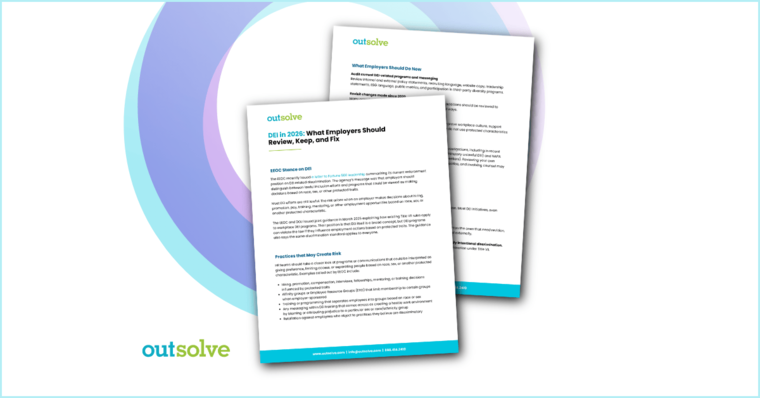
The recent letter from the EEOC to Fortune 500 leadership signals a renewed focus on ensuring Diversity, Equity, and Inclusion (DEI) initiatives align strictly with Title VII and other non-discrimination mandates. While the agency confirms that most inclusion efforts remain lawful, employers must now carefully distinguish between broad outreach programs and decision-making processes that could be viewed as using protected traits like race or sex as determining factors.

Here's What You'll Learn
- HR teams should review hiring, promotion, and compensation practices to ensure protected characteristics are not influencing employment decisions.
- Organizations need to examine internal and external messaging to verify that they don't inadvertently suggest exclusivity toward any group.
- Rather than dismantling all DEI initiatives, employers should focus on refining programs to prioritize access, fairness, and consistency, ensuring they remain lawful while still supporting a diverse workforce.
EEOC Stance on DEI
The EEOC recently issued a letter to Fortune 500 leadership summarizing its current enforcement position on DEI related discrimination. The agency’s message was that employers should distinguish between lawful inclusion efforts and programs that could be viewed as making decisions based on race, sex, or other protected traits.
Most DEI efforts are still lawful. The risk arises when an employer makes decisions about hiring, promotion, pay, training, mentoring, or other employment opportunities based on race, sex, or another protected characteristic.
The EEOC and DOJ issued joint guidance in March 2025 explaining how existing Title VII rules apply to workplace DEI programs. Their position is that DEI itself is a broad concept, but DEI programs can violate the law if they influence employment actions based on protected traits. The guidance also says the same discrimination standard applies to everyone.
Practices that May Create Risk
HR teams should take a closer look at programs or communications that could be interpreted as giving preference, limiting access, or separating people based on race, sex, or another protected characteristic. Examples called out by EEOC include:
- Hiring, promotion, compensation, interviews, fellowships, mentoring, or training decisions influenced by protected traits
- Affinity groups or Employee Resource Groups (ERG) that limit membership to certain groups when employer-sponsored
- Training or programming that separates employees into groups based on race or sex
- Any messaging within DEI training that comes across as creating a hostile work environment by blaming or attributing prejudice to a particular sex or race/ethnicity group
- Retaliation against employees who object to practices they believe are discriminatory
What Employers Should Do Now
-
Audit current DEI-related programs and messaging
Review internal and external policy statements, recruiting language, website copy, leadership statements, ESG language, public metrics, and participation in third-party diversity programs. -
Revisit changes made since 2020
Many organizations expanded DEI efforts after 2020. Those additions should be reviewed to confirm that they are still structured and described in lawful ways. -
Focus on access, fairness, and consistency
Programs that broaden opportunity, strengthen inclusion, improve workplace culture, support compliance, and reduce bias are still appropriate when they do not use protected characteristics as a basis for employment decisions. -
Review your data
The EEOC is actively seeking broad sets of employer data in investigations, including in recent subpoena enforcement actions involving Nike (alleging discriminatory unlawful DEI) and NAPA Auto Parts (alleging discrimination in hiring against Black job seekers). Reviewing your own decision-making patterns through analytics remains a best practice, and involving counsel may help protect those analyses.
“The EEOC is aggressively pursuing information about employer DEI programs and other potentially discriminatory practices. Employers should be evaluating their DEI programs but also should be continuing to assess their employment decisions for disparities by gender and race/ethnicity. Despite the focus on DEI initiatives, non-discrimination remains the law of the land under this EEOC and will continue to be under future administrations,” Josh Roffman, Managing Attorney at Roffman Horvitz, PLC states.
What Employers Should Not Do
-
Do not assume you need to dismantle every DEI initiative.
That is often an overreaction and can create unnecessary disruption. Most DEI initiatives, even under the guidance from the Trump EEOC/DOJ, are lawful. -
Do not chase the latest trend or headline.
The better approach is to keep initiatives that are clearly lawful, tighten the ones that need revision, and be thoughtful about how programs are described internally and externally. -
Do not rely on “business necessity” or customer preference to justify intentional discrimination.
The EEOC expressly says those are not defenses to intentional discrimination under Title VII.
What This Means for Your Organization
Keep in place DEI programs that are practical, lawful, well-documented, and aligned with equal employment principles. Keep what works and correct what might create risk.
Ask these questions:
- Does this program expand opportunity for everyone rather than just a protected group?
- Could a reasonable employee view this as affecting employment opportunities based on race, sex, or another protected trait?
- Are we using careful language in policies, goals, public statements, and reporting?
- Have we reviewed both current programs and older statements that regulators could revisit?
How OutSolve Can Help
OutSolve can help employers perform an objective Review-Keep-Fix analysis. This assessment identifies which programs are lawful and which may need adjustment to reduce potential risks. Contact OutSolve today to protect your organization through a comprehensive DEI audit.
DEI Development in 2026 Webinar
Watch our DEI Developments in 2026: An Employer Update webinar on-demand. This session features OutSolve CEO, Jeremy Mancheski, and Roffman Horvitz attorneys, Josh Roffman and Alissa Horvitz, breaking down the most important activity at a federal and state level regarding DEI. It also includes EEOC enforcement, OFCCP updates, and litigations tied to anti-DEI orders. Download the recording today.


Comments