For HR professionals working in federal contracting, compliance isn’t one single responsibility, it’s a collection of overlapping rules that touch hiring, pay, documentation, and reporting throughout the entire employee lifecycle.
While each requirement on its own is manageable, the challenge is what happens when they all stack together. That’s when you have different agencies, different deadlines, different systems, and different definitions of what “compliance-ready” actually looks like. And these priorities can have variable due dates throughout the year.
This is where the pressure shows up. It’s not so much in understanding the laws, but in keeping everything aligned and current without creating extra administrative work for your team.
This post breaks down the following requirements that federal contractors deal with day to day. Click on any of the topics below to jump to that section.

Title VII of the Civil Rights Act
Title VII prohibits employment discrimination based on race, color, religion, sex, or national origin, and it remains the foundation of federal contractor anti-discrimination obligations. Even after the repeal of EO 11246's affirmative action mandates, Title VII continues to govern everyday employment decisions for contractors.
Who Must Comply
- Employers with 15+ employees
- All federal contractors, regardless of contract value
Key Requirements
- Prohibit discrimination in hiring, firing, promotion, compensation, and other employment terms. Maintain employment records for EEOC review.
- Respond to discrimination complaints and investigations.
- Ensure that DEI programs comply with anti-discrimination standards.
Deadlines - No annual filing requirement exists. However, contractors must respond promptly to EEOC investigations. Employees must file discrimination complaints within 180 to 300 days of the alleged act, depending on state or local law.
Penalties - EEOC remedies include reinstatement, back pay, compensatory and punitive damages, and court-ordered policy changes. For contractors, noncompliance can result in debarment and contract suspension.
Managing Compliance - Title VII compliance is embedded in everyday HR operations such as hiring, promotions, terminations, and policy development. Internal teams mostly manage day-to-day decisions, but experts can provide policy audits, complaint-response support, and training to ensure practices remain defensible, particularly as DEI programs are scrutinized under EO 14173.
Equal Pay and Compensation Discrimination
Federal law prohibits compensation discrimination based on sex, race, color, religion, national origin, age, and disability. The Equal Pay Act ensures equal pay for equal work regardless of sex, while Title VII, the Americans with Disabilities Act (ADA), and the Age Discrimination in Employment Act (ADEA) extend protections against discriminatory pay practices to additional protected classes.
Together, these laws create overlapping compliance obligations that require employers to evaluate pay structures, document compensation decisions, and address unexplained disparities before they escalate into enforcement actions.
Who Must Comply
- Equal Pay Act: All employers
- Title VII and ADA: All federal contractors and employers with 15+ employees
- ADEA: Employers with 20+ employees
Key Requirements
Equal Pay Act
- Ensure equal pay for similar work requiring equal skill, effort, responsibility, and working conditions.
- Permissible differences must be based on seniority, merit, quantity or quality of production, or bona fide factors unrelated to sex.
Title VII, ADA, and ADEA
- Apply Equal Pay Act criteria.
- Incorporate a broader analysis of employment decisions, intentional discrimination, disparate treatment, and disparate impact.
Deadlines - There are no filing requirements for equal pay and compensation discrimination, though requirements exist for formalized complaints:
- Equal Pay Act: Complaints must be filed within two years of the violation (three years if willful).
- Title VII, ADA, and ADEA: Charges must be filed within 180 to 300 days of the discriminatory act, depending on applicable state law, with the clock resetting with each discriminatory paycheck.
Penalties
Equal Pay Act
- Penalties include back pay, liquidated damages (if willful), injunctive relief, and attorney fees.
- Federal contractors may face debarment or contract loss.
Title VII, ADA, and ADEA
- Penalties include back pay, compensatory and punitive damages, injunctive relief, attorney fees, and broader remedies for intentional discrimination.
Managing Compliance - Pay equity compliance requires proactive analysis and defensible documentation. Employers should establish clear compensation structures based on legitimate business factors such as seniority, merit, education, experience, or geographic location.
Regular pay equity audits can identify unexplained disparities, while consistent recordkeeping of salaries, raises, bonuses, and promotion decisions provides documentation during claims or investigations. Best practices include engaging a third-party consultant and conducting analyses under attorney-client privilege.

Labor Law Posters for Federal Contractors
Federal contractors must display required labor law posters at all worksites to inform employees of their rights under various laws and executive orders. These requirements extend beyond standard employer postings and include contractor-specific notices that must be updated as regulations change.
Who Must Comply
- All federal contractors and subcontractors at every establishment where contract-related employees work, and where certain dollar thresholds are met
Key Requirements
Required posters include:
- EEO Is the Law/Know Your Rights (2025 version) Pay Transparency Nondiscrimination Provision
- Federal Minimum Wage (EO 13658 and EO 14026, updated for 2025) Employee Rights Under the NLRA (EO 13496)
- Service Contract Act and Davis-Bacon Act (for applicable contracts) USERRA, E-Verify, FMLA, OSHA, and EPPA posters, as applicable
- Any state- or municipality-specific posters, as applicable
Deadlines - Posters must be displayed as soon as a federal contract becomes effective and updated immediately when DOL issues mandatory revisions.
Penalties - Per-violation fines range from $216 for the Family and Medical Leave Act (FMLA) to $26,262 for the Employee Polygraph Protection Act (EPPA). Noncompliance can trigger OFCCP conciliation agreements, contract breaches, and debarment.
Managing Compliance - Many contractors use an all-in-one labor law poster subscription, in which they automatically receive updated posters when changes occur. Subscriptions support compliance across multi-location operations and remote workforces, ensuring digital access and up-to-date physical postings, reducing audit risk and administrative burden.
Form I-9 Compliance
Form I-9 documents employment eligibility for every U.S. hire and is required for all employers, including federal contractors. In 2023, DHS made a version of remote verification a permanent option for employers who are enrolled with E-Verify and in good standing.
Who Must Comply
- Every U.S. employer, including all federal contractors.
Key Requirements
- Employees complete Section 1 on or before the first day of work.
- Employers complete Section 2 within three business days, reviewing acceptable identity and work authorization documents.
- Federal contractors with FAR E-Verify clauses must verify all new hires and existing employees assigned to contracts through E-Verify.
- Forms for terminated employees must be retained for three years after hire or one year after termination, whichever is later.
- Maintain all forms and documentation, ensuring accuracy and thoroughness.
Penalties - Paperwork fines range from $288 to $2,861 per violation. Knowingly hiring unauthorized workers can result in fines up to $28,619 per instance, criminal prosecution, and debarment from federal contracts.
Managing Compliance - I-9 compliance demands consistent processes, staff training, and internal audits. While HR teams can manage forms manually, using electronic I-9 systems with built-in compliance checks will reduce errors. Consultants offer I-9 audits, correction protocols, and training to minimize enforcement exposure, which is especially critical as Immigration and Customs Enforcement (ICE) audits have intensified.

E-Verify
E-Verify is a mandatory electronic employment verification system for federal contractors with FAR E-Verify clauses in their contracts. The system compares Form I-9 data against government databases to confirm work authorization, adding a critical layer of verification beyond standard Form I-9 requirements.
Who Must Comply
- Prime contractors with federal contracts exceeding $100,000 in value and 120 days in length.
- Subcontractors with subcontracts over $3,500 must comply if the E-Verify clause flows down to their level.
Key Requirements
- Enroll in E-Verify within 30 days of contract award. Submit cases for all new hires within three business days.
- Verify existing employees assigned to federal contracts within 90 days. Option to verify the entire workforce within 180 days.
Penalties - Penalties include contract suspension, debarment, and fines up to $3,000 per unauthorized employee for repeat offenders. State-level E-Verify penalties may include daily fines or loss of a business license.
Managing Compliance - E-Verify requires careful handling of Tentative Nonconfirmations (TNCs) and strict adherence to employee rights protocols. Internal teams can manage enrollment and queries, but consultants integrate E-Verify with I-9 systems, train staff on TNC procedures, and ensure federal and state compliance, thus reducing legal risk and operational disruption.

Building a Sustainable HR Compliance Strategy
Federal contractor compliance is complex, involving overlapping reporting cycles, evolving regulations, and significant penalties for missteps. Understanding how these laws and rules apply and coordinating them effectively remains a challenge, especially while maintaining accuracy across multiple data sources and deadlines.
Many contractors struggle with fragmented systems: One team manages AAPs, another handles EEO-1 filings, and I-9 compliance operates independently. This creates redundancy, increases the risk of error, and burdens HR teams with constant administrative firefighting. The alternative is an integrated HR compliance as a service (HR CaaS) approach that treats compliance as a unified system rather than a series of isolated obligations.
OutSolve helps organizations build sustainable compliance infrastructure by coordinating Section 503 and VEVRAA AAPs, managing EEO-1 and VETS-4212 reporting cycles, conducting DEI audits in alignment with EO 14173, assisting with equal pay and compensation discrimination, maintaining labor law poster compliance, and implementing I-9 systems with integrated E-Verify case handling. Our approach reduces administrative burden while ensuring audit-ready documentation and regulatory alignment.
Whether you need support for a specific compliance area or a comprehensive solution, OutSolve provides the expertise and systems that allow your HR team to focus on strategic workforce goals rather than regulatory administration.
Conclusion
At the end of the day, most compliance risks don’t come from not knowing the rules, but from gaps in coverage.
A missed poster update, an inconsistent I-9 process, a pay practice that isn’t well documented, or an E-Verify issue that isn’t handled correctly can all create exposure on their own. When they’re managed together though in a consistent system, the risk drops significantly.
For you and your HR team, the goal isn’t to turn compliance into something heavier. It’s to make it lighter by making it more consistent. Clear processes, clean data, and connected systems go a long way toward reducing stress during audit cycles or reporting seasons. Don't forget to check out Part 1 of our guide that covers requirements for Section 503, VEVRAA, EEO-1 Reports, VETS-4212 Reports, EO 14173 compliance, and EO 14398 compliance.
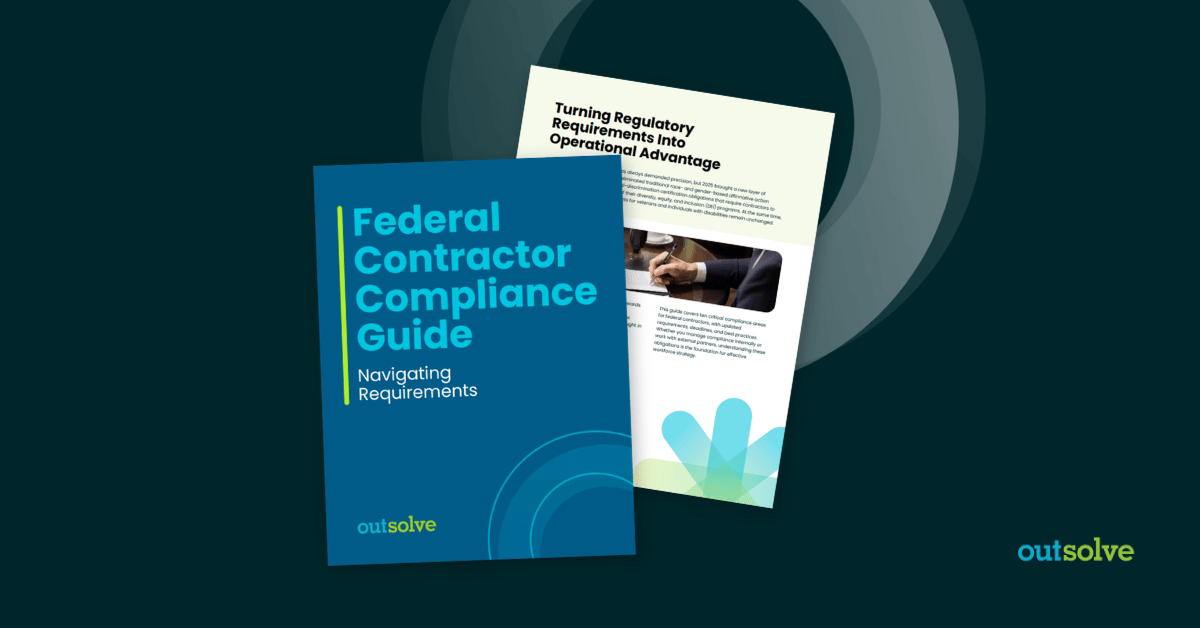
If you can get to a place where compliance feels predictable instead of reactive, then you’re already ahead of where most organizations are today. Get the full federal contractors compliance guide today and sure up your HR compliance plan.






Compensation Benchmarking: Save Your Q3/Q4 Hiring Goals
 Sarah Jane Hannan: Sep 2, 2026, 10:59:22 AM
Does your hiring in the second half of the year feel like a moving target? This can happen when compensation expectations shift faster than most...

Form I-9 Compliance: Best Practices for Management and Completion
 Desiree Throckmorton, SPHR: Aug 31, 2026, 1:35:05 PM
Employee onboarding includes so many moving parts, but few are as important as Form I-9 compliance. It doesn’t matter if you're hiring one employee...

Form I-9 Reverification: What Is It and Who Needs It for Compliance?
Desiree Throckmorton, SPHR: Aug 26, 2026, 9:15:00 AM
HR professionals already have enough on their plates, from recruiting and onboarding to benefits administration and compliance management. One task...