If you manage HR compliance involving a federal contract, then you’ve noticed that the rules keep changing and getting more complicated.
Between changing expectations around federal regulations, ongoing veteran and disability reporting, and new certification requirements tied to executive orders, it’s easy for compliance work to turn into an unknown constant cycle of deadlines, data cleanup, and reporting scrambles.
Most HR teams aren’t struggling because they don’t understand the requirements. They’re challenged because these obligations are constantly changing, housed in different systems, and owned by different people with different timelines. That’s where things start to break down.
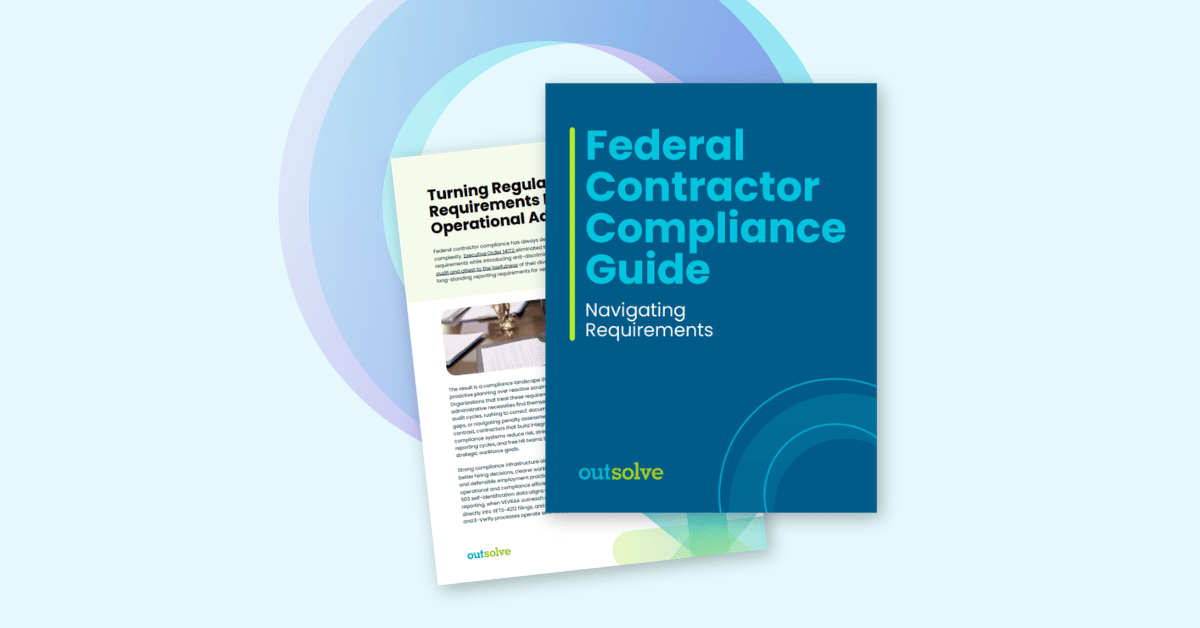
The good news is that when you start connecting the dots between these requirements, compliance becomes more manageable and a lot less reactive. Part 1 of this guide walks through six of the key federal contractor obligations and how they fit together in practice.

Turning Regulatory Requirements into Operational Advantage
Federal contractor compliance has always demanded precision, but recent changes brought a new layer of complexity. Executive Order 14173 eliminated traditional race- and gender-based affirmative action requirements while introducing anti-discrimination certification obligations that require contractors to audit and attest to the lawfulness of their diversity, equity, and inclusion (DEI) programs. At the same time, long-standing reporting requirements for veterans and individuals with disabilities remain unchanged.
The result is a compliance landscape that rewards proactive planning over reactive scrambling.
Organizations that treat these requirements as administrative necessities find themselves caught in audit cycles, rushing to correct documentation gaps, or navigating penalty assessments. By contrast, contractors that build integrated HR compliance systems reduce risk, streamline reporting cycles, and free HR teams to focus on strategic workforce goals.
Strong compliance infrastructure also supports better hiring decisions, clearer workforce analytics, and defensible employment practices. You build operational and compliance efficiency when Section 503 self-identification data align with EEO-1 reporting, when VEVRAA outreach efforts feed directly into VETS-4212 filings, and when Form I-9 and E-Verify processes operate seamlessly.
Section 503 of the Rehabilitation Act
Section 503 requires federal contractors to take affirmative action to recruit, hire, promote, and retain individuals with disabilities. With the 7% workforce utilization goal still in effect under EO 14173, contractors must maintain compliant affirmative action plans (AAPs) and self-identification processes, even as race- and gender-based plans are phased out.
Who Must Comply
- Contractors and subcontractors with contracts exceeding $20,000
- Those with 50+ employees and contracts of $50,000+
Key Requirements
- Maintain a 7% utilization goal for individuals with disabilities in each job group (or across the workforce for smaller contractors). Note: The Department of Labor has proposed eliminating this goal but hasn’t finalized such action as of November 2025.
- Invite applicants and employees to self-identify in the application stage, post-offer, and every five years using forms approved by the Office of Federal Contract Compliance Programs (OFCCP).
- Review and update AAPs annually and maintain records for up to three years, depending on the contract level and number of employees.
AAP Deadlines - AAPs must be updated annually and made available for OFCCP inspection. Self-identification surveys must be provided to job applicants after a job offer is made. Meanwhile, the entire workforce must be resurveyed at least once every five years.
Penalties - Penalties for noncompliance include contract cancellation, suspension, termination, and debarment. OFCCP investigations can result in back pay, reinstatement, and mandatory policy changes.
Managing Compliance - Contractors should work with compliance consultants to maintain AAPs and automate self-identification processes. This frees up HR capacity for strategic initiatives
Vietnam Era Veterans' Readjustment Assistance Act (VEVRAA)
VEVRAA requires federal contractors to take affirmative action for protected veterans, including disabled veterans, recently separated veterans, and those with wartime or campaign service.
Who Must Comply
- Those with 50+ employees and a single contract of $200,000 must develop annual AAPs
Key Requirements
- Establish a hiring benchmark using the one provided by the OFCCP (currently 5.1%) or establish your own following the OFCCP-prescribed methodology.
- List all job openings with the appropriate state Employment Service Delivery System (ESDS). Conduct veteran-focused outreach and document recruitment efforts.
- Maintain an AAP for veterans at each establishment.
Deadlines - AAPs must be updated annually in accordance with the above requirements.
Penalties - Penalties include contract suspension, termination, debarment, and corrective action orders. The OFCCP can mandate back pay and policy revisions.
Managing Compliance - VEVRAA compliance requires coordination across recruiting, HR information systems (HRIS), and other reporting systems. While internal teams might be able to manage filings effectively, partnering with specialists ensures accurate ESDS postings and benchmark assessments, particularly for multi-location contractors juggling establishment-level AAPs

EEO-1 Reports
The EEO-1 report provides the Equal Employment Opportunity Commission (EEOC) with annual workforce demographic data to monitor compliance with equal employment opportunity (EEO) laws.
Who Must Comply
- Private employers with 100+ employees
- Federal contractors with 50+ employees and contracts of $50,000+
Key Requirements
- Report employees by establishment.
- Summarize data by EEO-1 job category, race, ethnicity, and gender.
- Use male/female classifications only (nonbinary option removed for 2024 data).
- Ensure EEO-1 job classifications are accurate and aligned with operational roles.
Deadlines - Typically in the spring. The 2024 data collection opened May 20, 2025, and closed June 24, 2025. Late submissions were not accepted. Monitor EEOC announcements for the 2026 window.
Penalties - Failure to file can trigger EEOC investigations, loss of federal contract eligibility, civil litigation, and compliance letters. Fines are enforced for noncompliance.
Managing Compliance - EEO-1 reporting requires data accuracy at the job classification level, which can be challenging for organizations with complex structures. Internal HR teams often handle this using the EEOC portal, but consultants can validate job category assignments, ensure demographic data integrity, and coordinate with AAP cycles to prevent discrepancies.
 VETS-4212 Reports
The VETS-4212 report supports VEVRAA enforcement by annually tracking veteran applicants and new hires. This filing requirement stands out for its broad applicability and focus on demonstrating measurable progress in veteran recruitment.
Who Must Comply
- All federal contractors with at least one federal contract of $200,000 or more, regardless of employee count.
Key Requirements
- Report on total employees and protected veteran employees by EEO-1 job category at each establishment.
Deadlines - VETS-4212 reports must be filed between August 1 and September 30 each year, covering a workforce snapshot from July–August (or December 31 of the prior year if EEO-1 reports were filed with December 31 data) and new-hire data for the prior 12 months.
Penalties - Failure to file can result in loss of federal contract eligibility, contract suspension, or contract termination.
Managing Compliance - VETS-4212 preparation demands coordination between veteran self-identification data, HRIS records, and establishment-level reporting. Internal teams can use the DOL web-based system, while consultants streamline multi-location batch uploads, validate veteran status documentation, and ensure consistency with AAP data, reducing filing errors.
 EO 14173: Ending Illegal Discrimination and Restoring Merit-Based Opportunity
EO 14173 requires the inclusion of two clauses pertaining to DEI in every federal contract or grant award. The clauses require the fund recipient to (1) agree that compliance with Federal anti-discrimination laws is “material to the government’s payment decision” under the False Claims Act (FCA) and (2) “certify that it does not operate any programs promoting DEI that violate any applicable Federal anti-discrimination laws.”
Who Must Comply
- All recipients of federal funds with a contract or grant award that includes the two clauses from the EO must comply with EO 14173.
Key Requirements
- Certify that the organization does not operate any programs promoting DEI that violate any applicable Federal anti-discrimination laws.
Deadlines - Further clarification on the process and regulatory implementation of the certifications for EO 14173 is pending.
Penalties - Misrepresenting compliance with EO 14173 can trigger litigation under the False Claims Act, including financial penalties. Other ramifications include criminal penalties in egregious cases, debarment, contract cancellation, termination, or suspension, and Department of Justice or EEOC investigations, including whistleblower lawsuits.
Managing Compliance - EO 14173 compliance should include workforce analytic audits, DEI program audits, documentation of merit-based justifications, and development of attestation procedures.
EO 14398: Addressing DEI Discrimination by Federal Contractors
EO 14398 addresses DEI activities by federal contractors that discriminate via disparate treatment by race or ethnicity and require a certification clause in contracts. EO 14398 requires the inclusion of a six-paragraph clause in every federal contract.
Who Must Comply
- All contractors or subcontractors with a contract that includes the six-paragraph clause from the EO must comply with EO 14398.
Key Requirements
- Agree that the organization will not engage in activities that involve disparate treatment based on race or ethnicity in the recruitment, employment, contracting, program participation, or allocation or deployment of an entity's resources.
- Agree that the organization will report any subcontractor's known or reasonably knowable conduct that may violate this clause to the contracting department or agency and take any appropriate remedial actions directed by the contracting department or agency.
- Agree that the organization will furnish all information and reports, including providing access to books, records, and accounts, as required by the contracting agency so it can ascertain compliance.
Deadlines - Contracting agencies are required to include the clauses in new contracts by April 24, 2026, and existing contracts by July 24, 2026.
Penalties - Misrepresenting compliance with EO 14398 can trigger litigation under the False Claims Act, including financial penalties. Other ramifications include criminal penalties in egregious cases, debarment, contract cancellation, termination, or suspension, and Department of Justice or EEOC investigations, including whistleblower lawsuits.
Managing Compliance - EO 14398 compliance should include workforce analytic audits, DEI program audits, documentation of merit-based justifications, development of attestation procedures, and reasonable oversight of subcontractors to confirm that both the contractor and subcontractor practices align with applicable federal anti-discrimination laws.
Conclusion
If there’s a common thread across all of these requirements, it’s that compliance works best when it’s connected.
When Section 503 data feeds cleanly into your reporting cycles, and VETS-4212 reports are well documented through your hiring process, and when your systems for hiring, verification, and reporting actually “talk” to each other, compliance stops feeling like a scramble and starts feeling like a process you can trust.
For most HR teams, that shift is the difference between constantly reacting to deadlines and actually getting ahead of them.
You don’t need more spreadsheets or more manual work. You need systems that reduce friction, improve consistency, and give you confidence that what you’re submitting would hold up under review.
The ultimate goal is making compliance something your team can manage predictably, instead of something that keeps pulling focus away from everything else for which HR is responsible.
Federal contractors have a lot of juggle and our guide was designed to help minimize the burden of decoding those regulatory requirements. If you found this first portion of the guide helpful, download the full guide to stay on top of all your compliance requirements. And don't forget to check out Part 2!






Compensation Benchmarking: Save Your Q3/Q4 Hiring Goals
 Sarah Jane Hannan: Sep 2, 2026, 10:59:22 AM
Does your hiring in the second half of the year feel like a moving target? This can happen when compensation expectations shift faster than most...

Form I-9 Compliance: Best Practices for Management and Completion
 Desiree Throckmorton, SPHR: Aug 31, 2026, 1:35:05 PM
Employee onboarding includes so many moving parts, but few are as important as Form I-9 compliance. It doesn’t matter if you're hiring one employee...

Form I-9 Reverification: What Is It and Who Needs It for Compliance?
Desiree Throckmorton, SPHR: Aug 26, 2026, 9:15:00 AM
HR professionals already have enough on their plates, from recruiting and onboarding to benefits administration and compliance management. One task...