









In the current landscape of 2026, the intersection of shifting federal policy and aggressive worksite enforcement has fundamentally redefined the stakes of I-9 compliance. OutSolve commissioned exclusive research into this topic. The Operational Impact of Intensified I-9 Enforcement report provides a critical analysis of how today’s intensified enforcement cycles create unprecedented operational and financial risks for employers across the United States.
Part 1 of our 2-part series dives into the significant increase in the number of Notices of Inspection issued in 2025 and breaks down the industries that are most likely to receive one and why.

Introduction
Worksite immigration enforcement in the U.S. is not a steady-state compliance risk—it expands and contracts based on presidential administration policies and priorities. Over the last three administrations, employers have seen just how quickly the operational “temperature” can change. When immigration enforcement is emphasized, worksite enforcement tools—especially Form I-9 inspections/audits—become a high-frequency disruption. These audits often begin with HR, but will then ripple through Legal, Compliance, Operations, IT, and even senior management.
This whitepaper examines how enforcement intensity shifted during the first Trump administration, the Biden administration, and the first year of the second Trump administration. Using recent enforcement trend data and the mechanics of I-9 inspections, we translate “policy change” into concrete operational realities: what breaks, what slows down, what costs time, and what resilient employers do differently to stay inspection-ready in any political environment.
I-9 Inspections
When Immigration and Customs Enforcement (ICE) initiates an I-9 inspection, the agency typically serves a Notice of Inspection (NOI) requiring the employer to produce a selection of Forms I-9s, along with additional documentation (e.g., payroll and tax records) on a short timeline—within three business days. ICE then audits for technical, procedural, and completeness. Often, the I-9 records are compared against the Department of Homeland Security and Social Security Administration data. These reviews will often trigger follow-up requirements, creating additional internal workload within the organization being audited.
An I-9 enforcement action imposes unique requirements on the company being audited. These include: rapid-response document production, sensitive internal investigations, and the need to coordinate across locations—often under regulatory scrutiny. For multi-site employers and heavily regulated industries, a single NOI can become an enterprise-wide event requiring data pulls from multiple HRIS instances, filing cabinets, and more.
ICE I-9 NOIs have increased exponentially during the first year of the current administration. For historical perspective, the following exhibits show the number of NOIs issued by fiscal year between 2016 and 2025. This timeframe includes the final year of the Obama administration, all of president Trump’s first term, Biden’s term, and the first fiscal year of Trump’s second term.
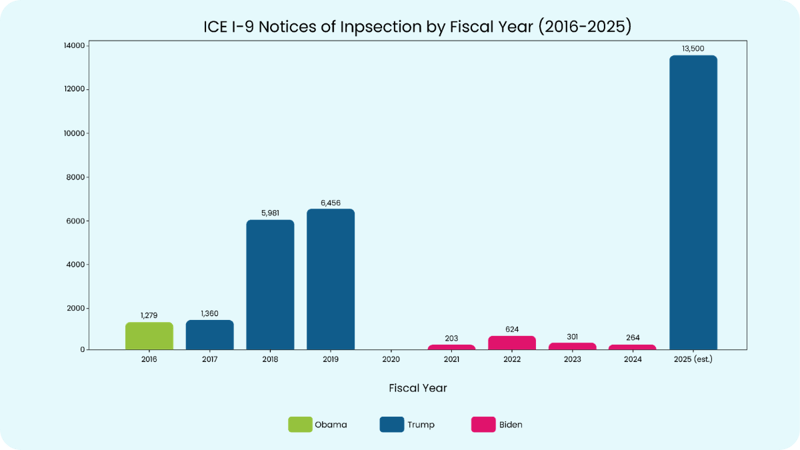
Sources: Economic Policy Institute (EPI) April 2025 FAQ reports ICE I-9 inspections by fiscal year (FY) (Oct 1–Sep 30). EPI also notes FY2020 inspection data were not publicly released. The April 2025 publication provides figures through FY2024. Because figures are reported by fiscal year, they don’t align perfectly to Inauguration Day, but the trend lines across administrations are still clear. Additional sources: Integrity Staffing, Fragomen Law, Trace Reports; ICE
Why Certain Industries are Targeted
A review of multiple DHS pronouncements, along with key immigration reporting (e.g. Immigration Insights & Issues), suggests that the impact of I-9 NOIs has not been evenly distributed across geographies and industries. It is clear that industries with the following characteristics will feel the most disruption over the coming years assuming elevated NOI/audit levels persist through:
- Higher shares of foreign-born workers
- High turnover/high-volume hiring
- Decentralized worksites
- Heavy use of subcontractors and staffing
Recent Examples of Significant I-9 Penalties
No organization is interested in announcing the fact that it is the subject of an ICE investigation. Therefore, information about specific cases is scarce. However, the Department of Homeland Security (DHS) does occasionally publicize ICE findings and fines, which can be substantial. This 2025 ICE press release identified three companies found to be in violation, along with their monetary fine amounts:
- CCS Denver, Inc: Fined $6,186,171 after a 100% substantive violation rate and evidence of knowingly hiring and employing at least 87 unauthorized workers.
- PBC Commercial Cleaning Systems, Inc: Fined $1,599,510 for a 74% violation rate and a pattern of knowingly employing at least 12 unauthorized workers.
- Green Management Denver: Fined $270,195 after a 100% violation rate and identification of 44 unauthorized employees.
The DHS press release states in part: “ICE Homeland Security Investigations’ worksite enforcement efforts focus on ensuring businesses comply with federal employment laws, primarily through I-9 audits, civil penalties, and criminal prosecution where applicable.”
It’s well established that companies with a large, relatively low pay, high-churn payroll are likely to have the most difficulty maintaining complete and accurate I-9 forms for all employees. The following is a list of industries likely to face more I-9 scrutiny than others.
Business Sectors Disproportionately Impacted by NOIs (2025–2028)
- Construction : Very high foreign-born proportion of workforce; decentralized jobsites; subcontracting; frequent project-based onboarding. Even a single NOI can force multi-tier contractor coordination and rapid document retrieval across sites.
- Hospitality & Food Service (restaurants, hotels, entertainment venues) : High churn, many locations, seasonal peaks, and lots of “distributed hiring”—conditions that magnify I-9 error rates and amplify the operational burden of an NOI response.
- Agriculture and related seasonal work : Seasonality + remote worksites + heavy reliance on immigrant labor means audits can collide with harvest/peak operations and create outsized disruption.
- Food manufacturing & processing : Often high immigrant labor share and shift-based operations; audits can trigger broad remediation efforts and, if separations occur, immediate throughout impacts.
- Staffing firms / labor contractors : High-volume onboarding is the “product.” A surge in NOIs tends to concentrate on employers that place large numbers of workers quickly—one audit can create cascading client-site issues. (Also a common enforcement focus historically during high-enforcement periods.)
- Transportation, warehousing, logistics: Large frontline workforces, multiple facilities, continuous hiring, and contractor/third-party labor models increase exposure when audit tempo rises.
- Building services (janitorial), landscaping, facilities management : Contracted labor + multiple client locations + frequent onboarding changes make I-9 process consistency hard—precisely the kind of operating model that becomes under repeated NOIs.
- Healthcare (especially long-term care, home health, and support roles) : Healthcare’s labor needs have grown sharply, and many roles rely on immigrant workers; audits can compound staffing shortages and overtime costs escalate quickly—especially in 24/7 care environments.
How Political Shifts Dictate Audit Risk
 As stated previously, intensified I-9 enforcement is not static—it rises and falls based on presidential enforcement priorities. As documented by the Economic Policy Institute in April of 2025, ICE I-9 inspections surged during the first Trump administration, declined during the Biden administration, and began increasing exponentially in 2025. This is a stark illustration of how politically driven enforcement cycles create operational volatility for employers. ¹
The calculations that support enhancing an organization’s I-9 processes – including the choice to work with an experienced I-9 management partner – must include more than an operational cost-benefit analysis. The decision must be informed by legal, operational, financial, and reputational considerations as well. And it is critical to understand that in the current political environment, I-9 non-compliance is an enterprise-level risk and should be managed accordingly.
Conclusion
For organizations in high-turnover or decentralized industries, the financial and reputational stakes have never been higher. As evidenced by multi-million-dollar fines issued recently, a high violation rate can be catastrophic.
Ultimately, intensified enforcement is a recurring cycle, but the current surge represents a fundamental shift toward direct employer accountability. Managing this risk requires more than a simple cost-benefit analysis; it demands a proactive strategy rooted in legal, operational, and financial foresight. To stay ahead, forward-thinking organizations must treat I-9 compliance not as a static obligation, but as a critical component of their broader risk management framework.
Stay tuned for Part 2 of our research report series that details why Form I-9 compliance is a governance imperative and the extreme operational and financial exposure that non-compliance can cause. You can download the full report here.

Report Sources
- Economic Policy Institute. Immigration enforcement and the workplace (April 2025).
- U.S. Citizenship and Immigration Services (USCIS). Handbook for Employers (M-274): Guidance for Completing Form I-9.
- U.S. Immigration and Customs Enforcement (ICE). Worksite Enforcement and Notice of Inspection Procedures.
- U.S. Immigration and Customs Enforcement (ICE), Civil Monetary Penalty Adjustments and I-9 Fine Matrix.
Note: ICE does not publish a standalone “fine matrix”; the penalty amounts and adjustments appear in the Federal Register - U.S. Department of Justice, Immigrant and Employee Rights Section. Employer Guidance on Avoiding Discrimination in the Form I-9 and E-Verify Process.

Comments