









August 2026 Update: A final rule issued in August 2026 made some changes to Section 503 and VEVRAA requirements. However, underlying obligations including completing written plans for both remains in place. Here is what changed: Section 503: Disability self-identification obligations and the 7% utilization goal were eliminated.
Federal contractors continue to face scrutiny when it comes to affirmative action and equal employment compliance. Section 503 of the Rehabilitation Act and the Vietnam Era Veteran’s Readjustment Assistance Act (VEVRAA) are two such regulations that directly impact how federal contractors recruit, document, train, and communicate across their organizations. Having a clear, reliable checklist on Section 503 and VEVRAA priorities and responsibilities helps employers move from reactive scrambling to proactive, audit -ready confidence.

Here’s What You’ll Learn
- Contractors must list all applicable external job openings with the state's Employment Service Delivery System (ESDS) and explicitly notify the agency that they are a federal contractor requesting priority referrals for protected veterans.
- Covered federal contractors must invite applicants to self-identify as individuals with disabilities or protected veterans at the pre-offer stage and then issue a second invitation post-offer (but before starting duties) to remain compliant. Section 503 also requires a resurvey of the entire workforce at least once in a 5-year period.
- To satisfy OFCCP requirements, contractors with 50 employees and $200,000+ in federal contracts must maintain detailed records for three years on applicant and hire data, outreach effectiveness evaluations, and recruitment benchmarks specifically for individuals with disabilities and protected veterans.

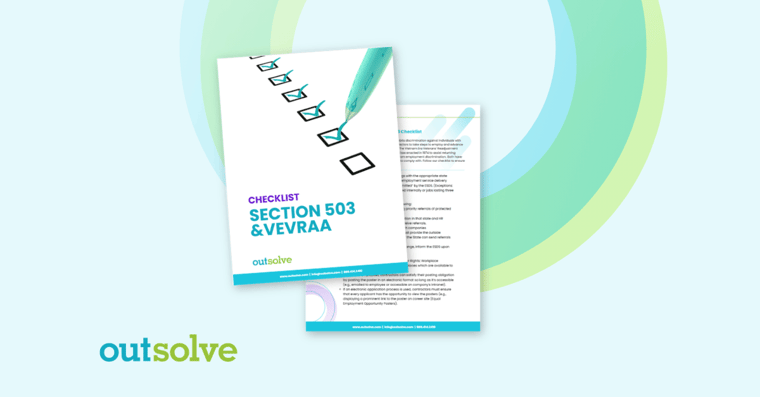
Section 503 is a federal law that prohibits discrimination against individuals with disabilities and requires federal contractors to take steps to employ and advance qualified individuals with disabilities. The Vietnam Era Veterans’ Readjustment Assistance Act, or VEVRAA, is a federal law enacted in 1974 to assist returning Vietnam veterans and protect them from employment discrimination. Both have key aspects federal contractors need to comply with. Follow our checklist to ensure you are complying with both.
- Contractors must list all external job openings with the appropriate state workforce agency, job bank or each state’s employment service delivery system (ESDS) in a manner and format “permitted” by the ESDS. (Exceptions: Executive/Senior level management, jobs filled internally or jobs lasting three days or less).
- Inform each State Agency or ESDS of the following:
- The organization is a federal contractor requesting priority referrals of protected veterans for our job openings.
- Provide the address of each hiring location in that state and HR contact who can verify information/receive referrals.
- If the Contractor uses outside job search companies (i.e. temp agencies), the Contractor must provide the outside companies' contact information so that the State can send referrals to those agencies.
- Should any of the above information change, inform the ESDS upon next job listing.
- Contractors must physically post the “Know Your Rights: Workplace Discrimination is Illegal” poster in conspicuous places which are available to employees and applicants.
- For remote employees, contractors can satisfy their posting obligation by displaying the poster in an electronic format so long as it’s accessible (e.g., emailed to employees or accessible on company’s intranet).
- If an electronic application process is used, contractors must ensure that every applicant can view the posters (e.g., displaying a prominent link to the poster on career site (Equal Employment Opportunity Posters).
- Check all State and Federal postings to ensure the most current are posted.
- If applicable, the contractor will notify union officials of company EEO Policy and commitment to Affirmative Action and non-discrimination against individuals with disabilities and/or protected veterans.
- The contractor will send the Know Your Rights poster to labor union officials.
- EOE Job Posting Tagline: Solicitations/Advertisements for Employees shall state that all qualified applicants will receive consideration for employment regarding their veteran status or on the basis of disability.
- Suggested Tagline on each posting: Equal Opportunity Employer / Veterans / Disabled.
- Reasonable Accommodation Policy: Contractors are encouraged, but not required, to develop a written procedure for processing requests for reasonable accommodation for disabled applicants/employees. If contractors choose to adopt this practice, guidance can be found at Appendix B to Part 60-741.
- Electronic/online job application system must inform applicants how to request reasonable accommodations so that they can participate fully in the application process.
- Purchase Order Required Language: Contractors must include, in bold font, an abbreviated version of the EO clause found in 60-300.5(a) and 60-741.5(a), in contracts, subcontracts, purchase orders and vendor agreements.
- The example statement below applies to subcontracts/purchase orders of $20,000 or more:
- This contractor and subcontractor shall abide by the requirements of 41 CFR 60-741.5(a). This regulation prohibits discrimination against qualified individuals on the basis of disability and requires affirmative action by covered prime contractors and subcontractors to employ and advance in employment qualified individuals with disabilities.
- The example statements below apply to subcontracts/purchase orders of $200,000 or more: (This includes the 13496 requirements.)
- This contractor and subcontractor shall abide by the requirements of 41 CFR 60-300.5(a) and 60-741.5(a). These regulations prohibit discrimination against qualified individuals based on their status as protected veterans or individuals with disabilities. Moreover, these regulations require that covered prime contractors and subcontractors take affirmative action to employ and advance in employment qualified protected veterans and individuals with disabilities. Contractor/subcontractor agrees to comply with all the provisions set forth in 29 CFR Part 471, Appendix A to Subpart A (Executive Order 13496)
- The example statement below applies to subcontracts/purchase orders of $20,000 or more:
- Contractors must send written notifications of company affirmative action policy to all subcontractors, including subcontracting vendors, requesting appropriate action on their part.
- Record Retention: Update record retention policies to ensure affirmative action records are kept for at least three years to account for Veterans/IWD requirements (including, but not limited to, applicants, hires, outreach/recruitment activities and benchmark/goal data).
- Post affirmative action policy statement on bulletin boards. Notices must be accessible and understandable (i.e., Braille or large print), and show support from chief executive.
- Availability of AAP: Narrative section of Veterans/Disability AAP needs to be made available to any employee or applicant upon request. Location and hours to be posted at each establishment.
- Pre-Offer Self ID: Contractors must invite applicants to voluntarily self-identify their protected veteran and disability status during the pre-offer stage.
- Contractors must use the prescribed form by the OFCCP to solicit disability information.
- These forms must be separate from the application.
- Veterans Post-Offer Self ID: Contractors must invite applicants (POST-OFFER) to identify as a protected veteran. The post-offer invitation may be made any time after an offer of employment has been made but must occur before the applicant begins his or her job duties.
- If an applicant identifies as a disabled veteran, the contractor should inquire whether an accommodation is necessary.
- Guidelines on a contractor's duty to provide reasonable accommodations can be found at Appendix A to Part 60-300.
- Disabled veterans' information must be maintained in a separate file and confidentiality protected.
- Disabled Post-Offer Self ID: Contractors must invite applicants (POST-OFFER) to identify as an individual with a disability. The post-offer invitation may be made any time after an offer of employment has been made but must occur before the applicant begins his or her job duties.
- Invite employees to self-identify as an individual with a disability in the first year the new §503 regulations are applicable and at five-year intervals after that.
- Remind employees at least once during five-year period they can voluntarily update their status.
- The information obtained by self-identification must be kept confidential and maintained in a data analysis file rather than in the employee's/applicant's medical file.
- The self-identification data must be maintained for three years.
- Periodically review personnel processes for effectiveness and to determine whether they screen out qualified protected veterans and/or qualified individuals with disabilities. Procedures which contractors may use to meet the requirements can be found at Appendix C to Part § 60-300.44(b).
- Review of Job Qualifications: Create a schedule for the periodic review of all physical and mental job qualifications to ensure any qualifications that eliminate applicants are job-related and consistent with business necessity.
- Develop and implement procedures against harassment due to protected veteran status or on the basis of a disability.
- Include Equal Opportunity Policy in manual or make it otherwise available to employees.
- Training: All personnel involved in recruitment, screening selection, promotion, discipline, and related processes shall be trained to ensure EEO commitments are implemented.
- Veterans/Disabled Data Collection: Contractors must create, maintain and retain the following records for three years, related to protected veterans and individuals with disabilities:
- the number of applicants who self-identified as protected veterans/individual with disabilities;
- the total number of job openings and total number of jobs filled;
- the total number of applicants for all jobs;
- the number of protected veteran applicants and applicants with disabilities hired; and
- the total number of applicants hired.
- Required Outreach: The contractor shall undertake appropriate outreach and positive recruitment activities, such as those listed in the Affirmative Action Plan, which are reasonably designed to effectively recruit individuals with disabilities and protected veterans.
- On an annual basis, contractors must review the previous 12 months of outreach/recruitment efforts to evaluate effectiveness and maintain documentation for three years.
- If the Contractor concludes the totality of its efforts were not effective in identifying and recruiting qualified disabled individuals, it shall implement alternative efforts to fulfill its obligations.
- Establish specific action-oriented programs to address any identified problems (i.e. modification of personnel processes to ensure equal employment opportunity, alternative or additional outreach and recruitment efforts, and/or other actions designed to correct the identified problem areas and attain the established goal).
- Contractor must implement an auditing system that periodically measures the effectiveness of the AAP efforts.
Checklist is subject to change as regulations are revised or implemented.

What Section 503 & VEVRAA Compliance Means for Your Organization?
Compliance is an ongoing commitment. When done correctly, Section 503 and VEVRAA compliance strengthens your recruiting strategy, improves documentation practices, and positions your organization for audits throughout the year.
Many contractors are shifting from reactive compliance to a proactive HR Compliance as a Service (HR CaaS) model. This adds expert guidance, ongoing monitoring, and audit defense into their processes and operations.
OutSolve can help you comply with both Section 503 and VEVRAA requirements. Reach out to use today to learn more about how we can help ensure your plans and reports are compliant with all current mandates.


Comments