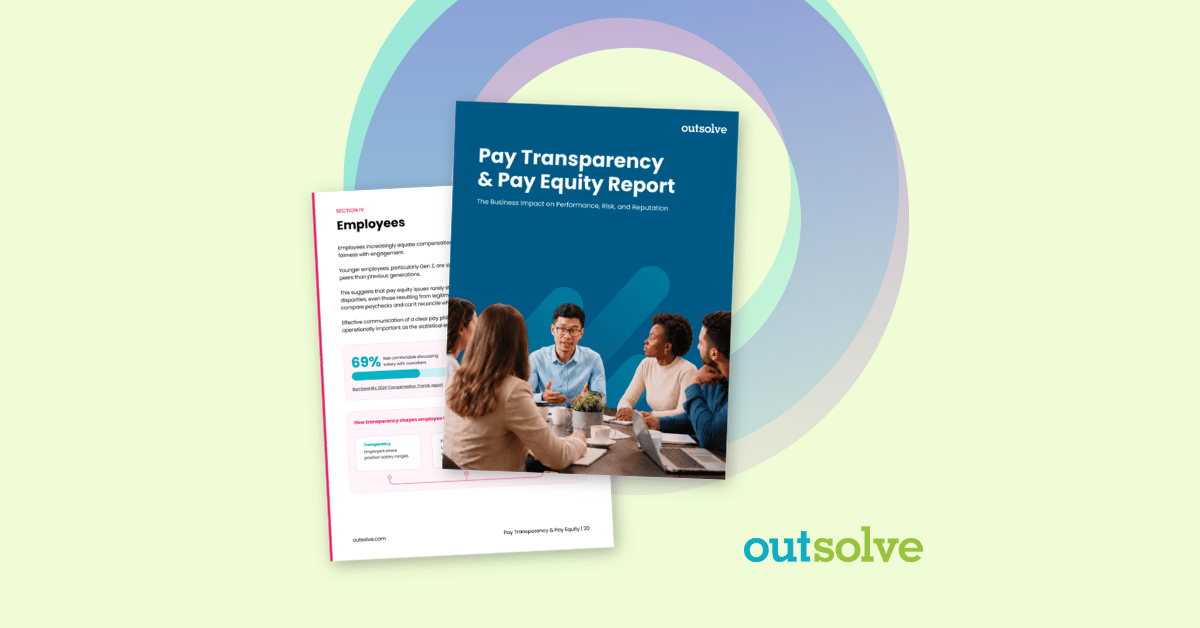
Compensation practices today are under a level of scrutiny we've never seen before. Employees are more willing to discuss pay with coworkers. Candidates expect salary ranges before they apply, and a growing number of states are requiring employers to be more transparent about how compensation decisions are made.
Many companies have historically viewed pay equity as something to address only when a problem surfaced, such as a complaint, audit, or a legal challenge. Pay equity should no longer be regarded as optional.
Some organizations approach pay transparency as a low priority “compliance project”. It's much bigger than that. Transparency has a way of exposing both the strengths and weaknesses of your company’s compensation strategy. Those with well-structured pay practices often build greater trust and credibility. On the flipside, those without may discover gaps they didn't know existed until questioned by employees or regulators.
The organizations getting ahead of this issue aren't waiting for a law to take action. They're looking closely at their compensation programs now and asking an important question, “If our pay practices were fully visible tomorrow, would we be confident defending them?”
Part 1 of our 2-part series examines the business case for pay equity and pay transparency, including the advantages of getting it right and the growing risks facing companies that don't.

Overview and Introduction
Pay equity and pay transparency have moved well beyond the walls of HR. They are now board-level governance issues, enterprise risk factors, and — increasingly — public-facing brand signals. For organizations that get it right, structured compensation programs deliver real competitive advantage: stronger talent pipelines, reduced litigation exposure, and a reputation for treating people fairly. For those that get it wrong, the consequences compound quickly.
The federal legal framework has been in place for decades. The Equal Pay Act of 1963 and Title VII of the Civil Rights Act of 1964 establish clear liability for unjustified compensation disparities based on sex, race, color, religion, and national origin. The EEOC recovered nearly $700 million for over 21,000 victims of employment discrimination in FY 2024 — the highest monetary recovery in recent agency history — while also receiving 88,531 new discrimination charges, a 9.2% increase over FY 2023.
Not surprisingly, the enforcement landscape has grown dramatically more complex. Layered on top of the federal framework is a rapidly growing patchwork of state and local legislation. As of early 2026, 25 Jurisdictions have enacted pay transparency laws, requiring employers to disclose salary ranges in job postings, prohibit reliance on pay history, and — in some states — report pay data to government agencies. Colorado's Equal Pay for Equal Work Act, California's Pay Transparency Law, New York's Labor Law §194-b, and a growing list of others (Illinois, Minnesota, Maryland, Massachusetts, New Jersey, and more) have dramatically raised the visibility of internal compensation decisions.
Despite the broad range of regulations designed to mitigate pay discrimination, large disparities persist, including a marked gender pay gap. According to the U.S. Census Bureau median earnings for women across all job types were 84% that of men.
To support our customers and the compliance community at large, the OutSolve Insights blog provides expert analysis and advice on a wide range of HR compliance topics including key legislative actions.
The core dynamic worth understanding here: transparency amplifies whatever compensation systems already exist. If your pay practices are equitable and well-documented, transparency builds trust. If they're inconsistent or undocumented, transparency creates exposure — legal, cultural, and reputational. Organizations that treat compensation compliance as a one-time audit rather than an ongoing governance priority often discover problems at the worst possible time: in the middle of litigation, a regulatory review, or a viral social media comment thread.
This white paper is designed to help executive and HR leaders understand the real business stakes of the rise in pay transparency requirements and the risks of ignoring clarity in workforce compensation. It also provides a strong case for partnering with experienced compliance consultant who help navigate these risks successfully
The Cost–Benefit Equation — Strategic Gains vs. Strategic Risk
Before organizations can make smart decisions about pay transparency and equity, they need a clear-eyed view of what's at stake on both sides of the ledger. The good news: companies that invest in structured, defensible compensation programs genuinely come out ahead. The bad news: the cost of getting it wrong has never been higher.
Benefits of Getting It Right
When compensation programs are built on rigorous pay equity analysis, clear job architecture, and defensible pay bands, organizations gain advantages that extend well beyond compliance.
- Reduced enforcement exposure. A pay equity analysis conducted with a compliance consultant firm provides a defensible foundation if the organization faces an EEOC inquiry, state-level audit, or private litigation. The analysis shows not just where the organization stands, but that it has proactively identified and addressed disparities.
- Internal trust and leadership credibility. Employees who understand how pay decisions are made — what factors influence compensation, how ranges are set, what drives advancement — tend to be more engaged and less likely to feel they've been treated arbitrarily. A transparent pay philosophy is a management tool, not just a compliance document.
- Workforce planning predictability. Structured pay bands and defined job architecture give finance and HR teams the data they need to model compensation budgets accurately, anticipate the impact of market adjustments, and make promotion decisions that don't create compression problems downstream.
- Investor and stakeholder confidence. ESG frameworks and SEC human capital disclosure guidance increasingly expect companies to demonstrate governance maturity around workforce practices. Proactive pay equity programs signal that leadership is managing human capital risk — not just reacting to it.
Risks of Getting It Wrong
The risks of inaction — or of implementing transparency without first conducting rigorous pay equity analysis — are significant, and they tend to compound.
Neil Dickinson, OutSolve VP of Compensation Services, suggest that “In today’s environment, a lack of pay transparency is not a neutral position. It can signal weak compensation governance, increase employee skepticism, and leave organizations more vulnerable when pay decisions are questioned by candidates, employees, or regulators”.
Key considerations include:
- Transparency before equity analysis is a liability, not a virtue. Posting salary ranges before understanding where internal disparities exist can expose unresolved gaps to employees, regulators, and employees simultaneously. The sequence matters enormously: equity analysis first, then transparency.
- Morale disruption and turnover. Unmanaged disclosure — where salary ranges are posted but not explained, or where ranges are accurate, but internal pay is not equitable — can trigger resentment, disengagement, and attrition among high performers who feel undervalued.
- Executive range disclosure creates special risks. Publishing salary ranges that include senior leadership positions can generate internal tension if those ranges are not carefully structured and clearly communicated as part of a coherent compensation philosophy. can generate internal tension if those ranges are not carefully structured and clearly communicated as part of a coherent compensation philosophy.
- In-house management increases error probability. Organizations that assign pay equity monitoring as a secondary responsibility to existing HR staff — without dedicated expertise, appropriate tools, or a full understanding of the legal and strategic implications — run the risk of making, and publishing, expensive mistakes.
The Business Impact — Operations, Finance, and Reputation
Pay equity and transparency issues don't stay in the HR department. When compensation systems are poorly designed or inadequately documented, the ripple effects reach operations, legal, finance, and other outward-facing elements of the business.
Operational Complexity
The administrative burden of compliance has grown substantially as state laws have multiplied and diverged.
Multi-state employers now face a patchwork of requirements with different thresholds, timelines, and definitions. Illinois’ pay transparency law (effective January 1, 2025) applies to employers with 15 or more employees. Minnesota's applies to those with 30 or more. Maryland, New Jersey, and Hawaii each have their own effective dates and scope rules. For employers with employees in multiple states, the compliance burden multiplies — not just for posting requirements, but for record-keeping, audit trails, and internal promotion announcement protocols.
The EEOC also plays a direct operational role: when compensation disparities surface in enforcement reviews or litigation, organizations that cannot produce documentation of their pay decision rationale face a rebuttable presumption of wrongdoing under some state laws. For example, the state of Colorado requires employers to maintain records of job descriptions and wage history for the duration of employment plus two years after separation. Failure to maintain those records can be used against an employer in litigation.
Implementing defensible pay bands and structured job architecture is not a one-time project — it requires ongoing maintenance. Market data shifts, roles evolve, and internal promotions create compression if not actively managed. Internal HR teams that lack specialized experience and legal resources to conduct pay equity analyses are frequently unable to sustain this monitoring at the required level of rigor.
Financial and Legal Exposure
The financial costs of pay equity failures are real and often underestimated until they materialize.
Pay equity remediation is rarely a one-time fix. When pay disparities are identified — whether internally or through litigation — correcting them typically requires permanent payroll adjustments. Those adjustments can create cascading compression effects across departments, as raising one employee's salary puts pressure on the ranges of peers and managers. Finance teams that are unprepared for these adjustments often find themselves in difficult budget conversations mid-cycle.
Litigation under the Equal Pay Act or Title VII can result in back pay awards, liquidated damages, civil penalties, and legal defense costs. As noted in a report from LIPP LAW, the EEOC filed 111 merit lawsuits and resolved 132 — with 97% resulting in outcomes favorable to the claimants who brought the case before the EEOC. For employers, that means once a matter reaches litigation, the odds are not favorable. And public settlements carry a multiplier effect: shareholder scrutiny, investor concern, and the reputational damage that follows front-page news of a pay discrimination settlement.
Reputational and Talent Market Effects
Compensation visibility is no longer bounded by legal requirements. It's a market reality.
Platforms like Glassdoor have fundamentally changed the information landscape. Employees and candidates share salary data publicly, compare it against posted ranges, and — critically — factor perceived fairness into job acceptance decisions. A Glassdoor survey conducted by Harris Poll found that 83% of U.S. employees and job seekers said transparency around pay is very or somewhat important to feeling included in the workplace. And 60% of respondents said they would not apply to a company where a pay gap exists.
Brand recognition and equity takes years to build and can erode quickly. Organizations that resist transparency — or are caught with opaque pay practices — risk losing top talent and being passed over by qualified new-hire candidates. Conversely, companies that communicate a clear, well-structured pay philosophy will likely outperform peers on retention and engagement metrics, because employees feel they understand the rules of the game.
The Problem with Outdated Pay Practices
Many organizations still rely primarily on salary surveys to set and adjust compensation. Salary surveys have real value — they tell you what the market is paying for comparable roles. But they are insufficient on their own, for two reasons. First, they are episodic: a survey conducted once a year captures a moment in time, not the ongoing drift of internal pay equity. Second, they reveal what the market pays, not where your organization is exposed. Only a structured pay equity analysis — conducted with statistical rigor — identifies whether your organization's actual compensation practices are creating disparities along gender, race, or other protected-class lines. Salary surveys and pay equity analysis are complements, not substitutes.
Conclusion
Compensation used to be confidential, but that’s no longer the case. Once pay becomes visible, it starts shaping how both employees and the public evaluate fairness, leadership, and even the organization’s credibility in the market.
The organizations managing this well aren’t reacting after the fact. They’re building structure before transparency forces their hand, because once compensation is visible, silence is no longer an option.
Stay tuned for Part 2 of our series that evaluates organizational dynamics, the strategic case for external expertise, and why organizations need to put pay transparency and equity at the forefront of their compensation strategies.






What Triggers an I-9 Audit? Key Factors You Should Know
 Desiree Throckmorton, SPHR: Oct 1, 2026, 10:15:00 AM
Verifying identity and work authorization through Form I-9 is one of the most important HR compliance responsibilities for U.S. employers. With...

Pay Transparency Laws Are Here. Is Your Pay Ready?
 Neil Dickinson: Sep 29, 2026, 9:10:27 AM
Pay transparency laws continue to change the way employers approach compensation. It started with a handful of state and local requirements and has...

Best Practices for HR: AI in Recruiting
 Renee Arazie: Sep 23, 2026, 1:29:28 PM
Artificial intelligence (AI) continues to change how HR teams approach recruiting, streamline processes, improve efficiency, and make more informed...