








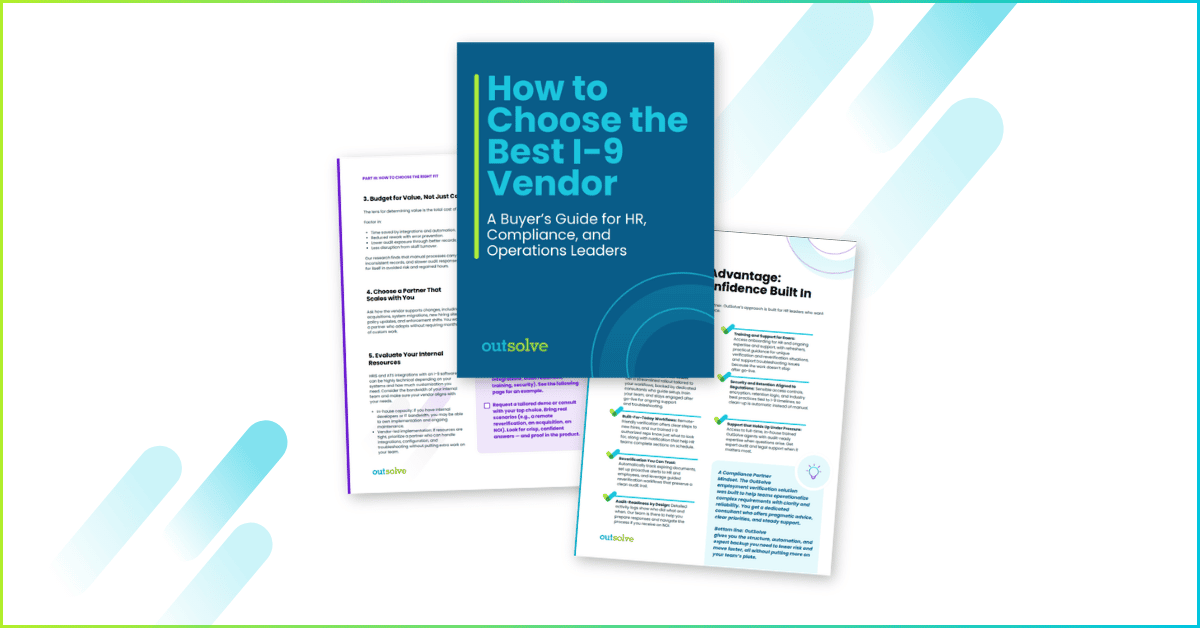
Choosing an I-9 vendor requires more than a checklist of features. The best vendors pair strong technology with reliable compliance support so your team can move faster while reducing audit exposure. The following breaks down eight key Form I-9 features you should be asking about when you are evaluating I-9 vendor partners.
Top Takeaways for HR
- Since untrained I-9 authorized representatives are a primary source of errors, you should prioritize vendors that offer role-based training, built-in submission checks, or a managed service model to provide completion of Section 2 verification.
- To move from a reactive to a proactive posture, your vendor must automate complex record retention math (e.g., the "three years after hire/one year after termination" rule) and maintain a timestamped audit trail that documents "good-faith" compliance efforts.
- For organizations utilizing hybrid or distributed workforces, remote document examination via the digital procedure is legally restricted to employers who are actively enrolled and in good standing with E-Verify.
List of I-9 Features to Evaluate
1. Legal Expertise and Risk Mitigation
As enforcement intensifies, the details matter. Your vendor should translate regulatory requirements into daily guardrails, so the right step is also the easy step. Look for:
- Up-to-date rule interpretation and guidance followed — including retention guidelines, document selection guidance, and reverification help
- Error-prevention and correction support for common issues, such as missing signatures or dates and incorrect section sequencing
- Practical escalation paths for handling edge cases like uncommon documents, timing issues, or corrections, including access to knowledgeable support
Auditors typically examine a selection of Form I-9s, looking for isolated errors and patterns of noncompliance. Vendors can help you standardize processes, create an audit trail, and document your good-faith efforts towards compliance by conducting self-audits, meaningfully reducing risk.
2. Remote I-9 Capabilities
Hybrid and distributed work have become standard. Your vendor should offer compliant remote-verification options that are simple for HR and employees alike. Keep in mind that the DHS remote document examination procedure is only available to employers enrolled in E-Verify. For organizations not enrolled in E-Verify, Section 2 must still be completed in person.
For remote-eligible employers, that means your vendor must have:
- Remote verification workflows that follow current rules and maintain an audit trail
- A streamlined I-9 authorized representative process including clear and consistent procedural guidance, defined eligibility criteria, and secure identity and document capture protocols.
A good remote process lowers error rates, increases on-time completion, and makes audit support easier by preserving evidence and timing data in one place.
3. HRIS/ATS Integration
Every manual touchpoint is a chance for data drift. Integrating with your HR information system (HRIS) or applicant tracking system (ATS) helps you auto-start the I-9 process at the right moment, pull in employee data, and sync to your systems of record. Look for:
- Out-of-the-box connectors or robust APIs compatible with your core HRIS and ATS
- Automated triggers (e.g., a “hire” action initiates I-9, reminders on day one and day three)
- Consistent identifiers and fields to avoid mismatches during audits
When I-9 data connects to your HR tech stack, audit readiness improves, completion times drop, and HR teams regain hours every week.
4. Managed Service vs. Software (And Why It’s Not Either/Or)
Some teams want maximum control of the tools they use, while others want a partner to share the load. Be candid about the level of guidance you’ll need. The options include:
- Software-led (Self-Service): You keep day-to-day ownership of the overall process and leverage vendor software to manage your Form I-9 procedures.
- Service-supported (Hybrid Model): You get the software plus hands-on onboarding and training, and the flexibility of outsourcing certain tasks to your compliance partner.
- Full service: You lean on a compliance partner for setup, end-to-end employment verification, change management, audit response coordination, and on-going support and expertise.
Consider frequent regulation changes, turnover on your HR team, recent hiring volume, multi-state management, and the complexity of your geographic location. For many organizations, a managed service, a strong compliance partner with credible expert support and delivers the best balance of control and coverage.
5. Audit Readiness and Preparation Assistance
In an audit, preparation beats improvisation. Ask prospective vendors to show you:
- A complete audit trail (who did what, when) with timestamps
- Exportable and organized records for the requested time window, including supporting documents and policy references
- Comprehensive I-9 playbooks which provide actionable guidance for responding to Notices of Inspection (NOIs), correcting technical errors, and documenting good-faith compliance efforts to mitigate enforcement risk.
Keeping detailed records, showing evidence of timing, and taking remediation actions can influence any I-9 audit’s findings.
6. Authorized Representatives: Training and Controls
Many errors result from untrained or undertrained I-9 authorized reps. Your vendor should help you set reps up for success with:
- Role-based access, with appropriate permissions
- Regular training and related documentation to support adoption and ease-of-use
- Built-in checks that catch common mistakes before submission
Some vendors offer trained I-9 authorized reps who complete this process for you. This eliminates your team having to stay up-to-date on work authorization or identity documents. But you need to understand if the representatives are full-time employees of the vendor or subcontractors.
Reducing preventable errors (including incorrect dates or document selection) is one of the fastest ways to reduce risk exposure and rework.
7. Reverification and Deadline Management
Missed reverification dates are easy to avoid but can be expensive mistakes. Your vendor should offer:
- Automated tracking of work authorization document expiration dates
- Proactive notifications to HR and employees at sensible intervals
- Guided workflows timely reverification and preserve a clean trail
Automated alerts are a key advantage of moving beyond manual or paper-based systems, which are prone to timing slips in high-volume environments.
8. Security, Retention, and Access Controls
You’re managing sensitive identity information during the I-9 process and beyond. Evaluate vendors for:
- Data protection practices (e.g., encryption in transit/at rest, certifications)
- Retention logic tied to regulatory retention timeframes for terminated employees (e.g., three years after hire or one-year post-termination, whichever is later)
- Granular access controls to minimize unnecessary exposure
Vendors should make doing the right thing the default. Instead of your team having to remember retention math, your systems should automate it.
What Choosing the Right I-9 Vendor Means for Your Organization
Selecting the right I-9 vendor is ultimately about reducing ICE audit risk and exposure while improving operational efficiency. Organizations that move beyond basic software and engage an HR compliance as a service (HR CaaS) partner for their I-9 management gain not only better tools, but also expert guidance, audit preparedness, and peace of mind.
If your current process feels reactive, manual, or unclear, it may be time to evaluate whether your vendor or manual process is truly supporting your compliance goals or simply skating by. The right partner will help you stay ahead of regulatory changes, reduce errors, and confidently manage audits.


Comments